Canada to Stall Electric Vehicle Rules as Carney Seeks to Boost Auto Sector
Canada is delaying a plan to force automakers to hit minimum sales levels for electric vehicles by 2026, a concession to manufacturers in a sector that has been upended by tariffs.
Prime Minister Mark Carney’s government will make the announcement Friday as one of a series of measures to help companies in the industries most affected by US President Donald Trump’s trade war, according to people familiar with the matter, speaking on condition they not be identified.
Carney’s predecessor, Justin Trudeau, had passed rules that required automakers to ensure that at least 20% of sales were zero-emission vehicles by the model year 2026. But the government won’t implement that target now: instead, it will launch a review of the so-called “electric vehicle availability standard” to make sure it doesn’t create burdens on automakers, the people said.
It’s another illustration of how Carney, who took over in March, is unwinding some policies of the Trudeau era, partly because of the pressures of the trade war. The prime minister has withdrawn many retaliatory tariffs on U.S. products, scrapped a carbon tax on consumers’ use of fossil fuels and ditched a new tax on digital services after Trump complained about it.
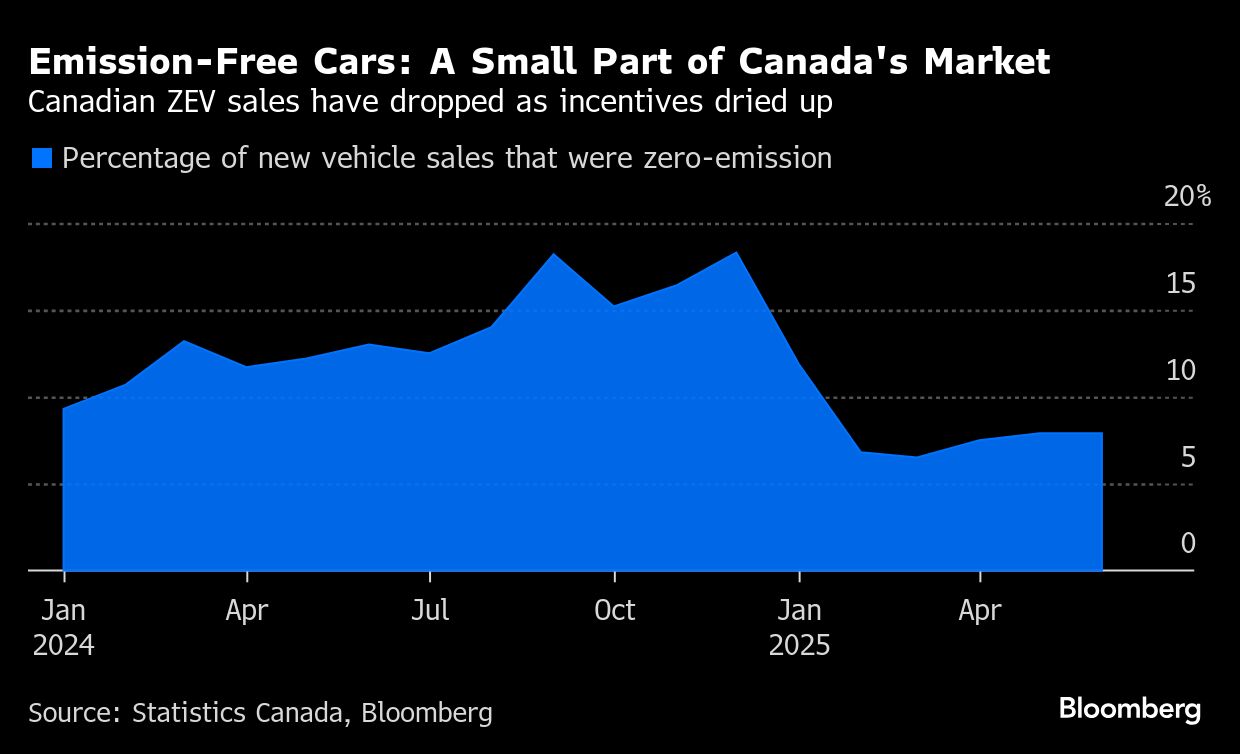
The auto industry has been lobbying for months to change the EV mandate, arguing that the targets were unrealistic and would add costs and put jobs at risk.
In June, about 8% of new vehicles sold in Canada were zero-emission. The percentage has declined this year because the federal government cut off a consumer incentive that had offered as much as C$5,000 ($3,622) to buyers of clean-energy vehicles, saying the program had run out of money.
The Trudeau electric vehicle standard raised the bar over time so that by 2035, all new cars and light trucks sold in Canada would have to be emissions-free.
“These targets were made up by the government, not based on any sound assessment of real market dynamics,” Brian Kingston, chief executive officer of the Canadian Vehicle Manufacturers’ Association, said in an interview in August. The CVMA represents General Motors Co., Ford Motor Co. and Chrysler parent Stellantis NV, all of which have manufacturing operations in the province of Ontario.
Under the electric vehicle mandate, manufacturers that failed to meet the sales targets would likely have been forced to restrict sales of internal combustion engine vehicles or buy credits from companies like Tesla Inc., Kingston said.
Automakers around the world are facing higher costs from U.S. tariffs, and EV manufacturers are also facing pressures from U.S. moves to gut fuel-efficiency rules and remove consumer tax credits for buying EVs.
The Canadian industry is highly integrated with the American auto sector: The country exports most of its vehicle production to the US, and imports more American cars and trucks than anywhere else. For that reason, automotive regulations in Canada have long tended to be similar to those in the U.S.
But the industry is now under threat from the Trump administration’s tariffs on foreign-made vehicles. GM and Stellantis have both curtailed production and reduced shifts at assembly plants in the province of Ontario since the trade war began.
When Trump imposed those tariffs in April, Canada retaliated by putting its own levies on U.S.-made vehicles — essentially matching the White House move.
But Carney’s government also gave automakers a way to apply for tariff relief, as long as they keep their production and investment in Canada.
Top photo: An electric vehicle at a charging station in Montreal, Quebec, Canada. Photographer: Graham Hughes/Bloomberg.
- Accenture Settles With Justice Department Over DEI Policies
- The Nation’s Insurance Laboratory: What Liability Trends in California Mean for the Rest of the Country
- The Great Hemp Reset: How the Federal Ban on Intoxicating Hemp Products Will Reshape Risk and Coverage
- The Big Data/AI ‘Revolution’ Is Driving Up Verdicts, Settlements as Plaintiffs Buy In