Carmakers Fight to Keep Going as Nexperia Chip Conflict Drags On
Europe’s auto industry is working around the clock to prevent the conflict with China over chipmaker Nexperia from triggering production outages.
Task forces at Volkswagen AG and ZF Friedrichshafen AG are scouring for replacement supplies and boosting semiconductor stockpiles. While there’s some success in tapping the likes of Germany’s Infineon Technologies AG for alternatives, output halts remain a risk, with one missing component sufficient to prevent new cars from leaving the factory.
France’s Valeo SE — whose customers include VW, Stellantis and Mercedes-Benz — has already found replacements for much of its automotive product range. Nexperia’s typical products are commodity chips, helping to speed the switch, according to Chief Financial Officer Édouard de Pirey.
Still, the industry remains concerned that the standoff involving the little-known Netherlands-based semiconductor maker escalates. In Germany, Robert Bosch GmbH is preparing to cut working hours at its Salzgitter site. The factory makes electronic control units and requires a continual flow of parts to stay operational, said Mario Gutmann, a Bosch works council official.
Beijing this month blocked Nexperia from exporting from its facilities in the country, responding to the Dutch government seizing control of the Chinese-owned chipmaker. The moves highlight worsening trade relations between China and the West, disrupting complex supply chains that have been built for years.
The fallout is already spreading beyond Europe. This week, Nexperia notified its Japanese automotive customers that it may no longer be able to guarantee deliveries.
A range of suppliers in Germany may be forced to reduce working hours next week because of the Nexperia chip shortages, said Horst Ott, regional director at the IG Metall union in Bavaria. The supply crunch, triggered by China-US geopolitical wrestling rather than market forces, has exposed a lack of resilience among manufacturers, he said.
“We’re prepared for short-term work everywhere,” Ott told reporters at an event organized by Germany’s IG Metall labor union in Munich, adding that greater clarity should come by Wednesday.
Bosch is trying to avoid outages by using alternative supply sources, optimizing inventory and processing technical alternatives. “But unless export control restrictions are eased, temporary production adjustments at individual Bosch plants cannot be ruled out,” the company said in a statement.
VW on Friday pledged that its factories in Europe’s biggest economy will be running through next week, but also didn’t want to rule out short-term disruptions. Europe’s biggest automaker is currently looking into alternative sourcing options.
Hundreds of Nexperia’s chips, while not considered high-tech, are found in a typical vehicle, where they act as electronic switches in many products including steering wheels. Alternative suppliers for similar products include Infineon, ON Semiconductor Corp. and STMicroelectronics NV.
The company operates sites in the UK and Germany, but also produces in China. Automakers are highly dependent on supplies from the Asian nation, with Beijing recently tightening control over rare earth minerals — key components for companies that make electric vehicles.
While the industry fights to keep production going, the political fallout from worsening relations with China is spreading. On Friday, German Foreign Minister Johann Wadephul canceled his first official trip to China just two days before he was set to depart because Beijing was able to confirm only one official meeting.
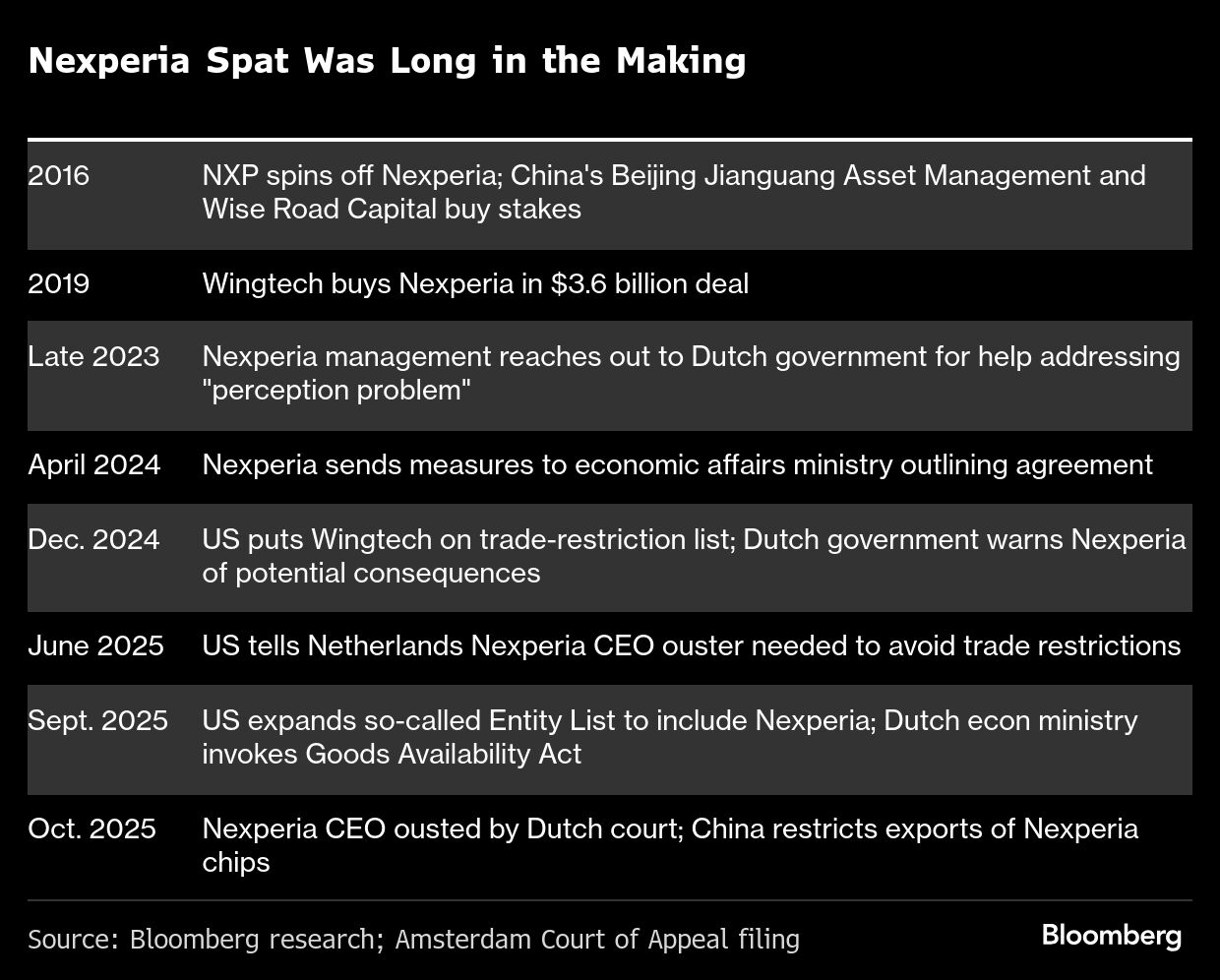
Nexperia Spat Was Long in the Making
Earlier this month, the Dutch government seized control of Nijmegen-based Nexperia in an unprecedented step intended to secure European access to the components made by the company. Owned by China’s Wingtech Technology Co., the chipmaker is now at odds with its Chinese unit, which earlier Friday said its business continues to be orderly and remains in compliance with Chinese regulations.
The rift, which was precipitated by the US threatening to put Nexperia on a no-trade list due to its association with Wingtech, has turned the company into a flashpoint for the US-China trade war and now threatens the broader automotive supply chain.
“Europe’s mobility transformation depends on a stable semiconductor ecosystem,” said Benjamin Krieger, secretary general of the European Association of Automotive Suppliers. Companies “are taking big hits as intermediate producers, operating between critical component factories and vehicle manufacturers.”
- Before the Nuclear Verdict: Rethinking How Liability Claims Are Managed
- Will California’s New Smoke Claims Law Create a Recovery Bottleneck?
- First Atlantic Hurricane of 2026 to Threaten US Gulf Coast
- Don’t Sweat the Heatwave, El Niño Is Cooking up Some Raucous Weather for California