US Decides Against Renewing USMCA, Shifting to Rolling Talks
The U.S. won’t renew its trade deal with Canada and Mexico, choosing instead to conduct annual reviews of the pact in a decision that risks adding uncertainty for companies producing goods across North America.
The U.S.-Mexico-Canada Agreement, or USMCA, will remain in force for another decade provided no one country decides to exit. Opting against a longer-term renewal opens the door to years of contentious negotiations over the rules governing continent-wide supply chains and low tariff levels vital for automakers, farmers, retailers and energy companies.
The Trump administration is “not prepared to rubber stamp the agreement,” U.S. Trade Representative Jamieson Greer said in an interview. “We think there are substantial issues.”
The decision marked a head-spinning reversal for President Donald Trump, who had rammed through the original USMCA in 2020 and once called it the “best and most important trade deal ever made.” Trump soured on the deal in his second term in part because it protects huge sections of trade from tariffs he sought to impose and did little to address trade deficits with Mexico and Canada.
The potential disruptions and the broad economic impact are stark. USMCA boosted economic activity between the three countries, which combined represent nearly a third of the world’s gross domestic product. Intraregional trade surpassed $1.6 trillion in 2024, up from $1 trillion when the agreement went into place in 2020.
On Wednesday, the six-year anniversary of USMCA’s inception, the countries could have extended the accord by 16 years. That scenario was unlikely, however, as Trump made clear he wanted changes or might opt to go it alone — part of a broader push by his administration to reshore manufacturing jobs and squeeze concessions from trading partners.
USMCA has provided a measure of stability in an otherwise turbulent period that included Trump’s tariff clashes with China and other major trading partners. His moves to impose new levies came alongside sweeping exemptions for USMCA-qualified products, easing the blow on Mexico and Canada.
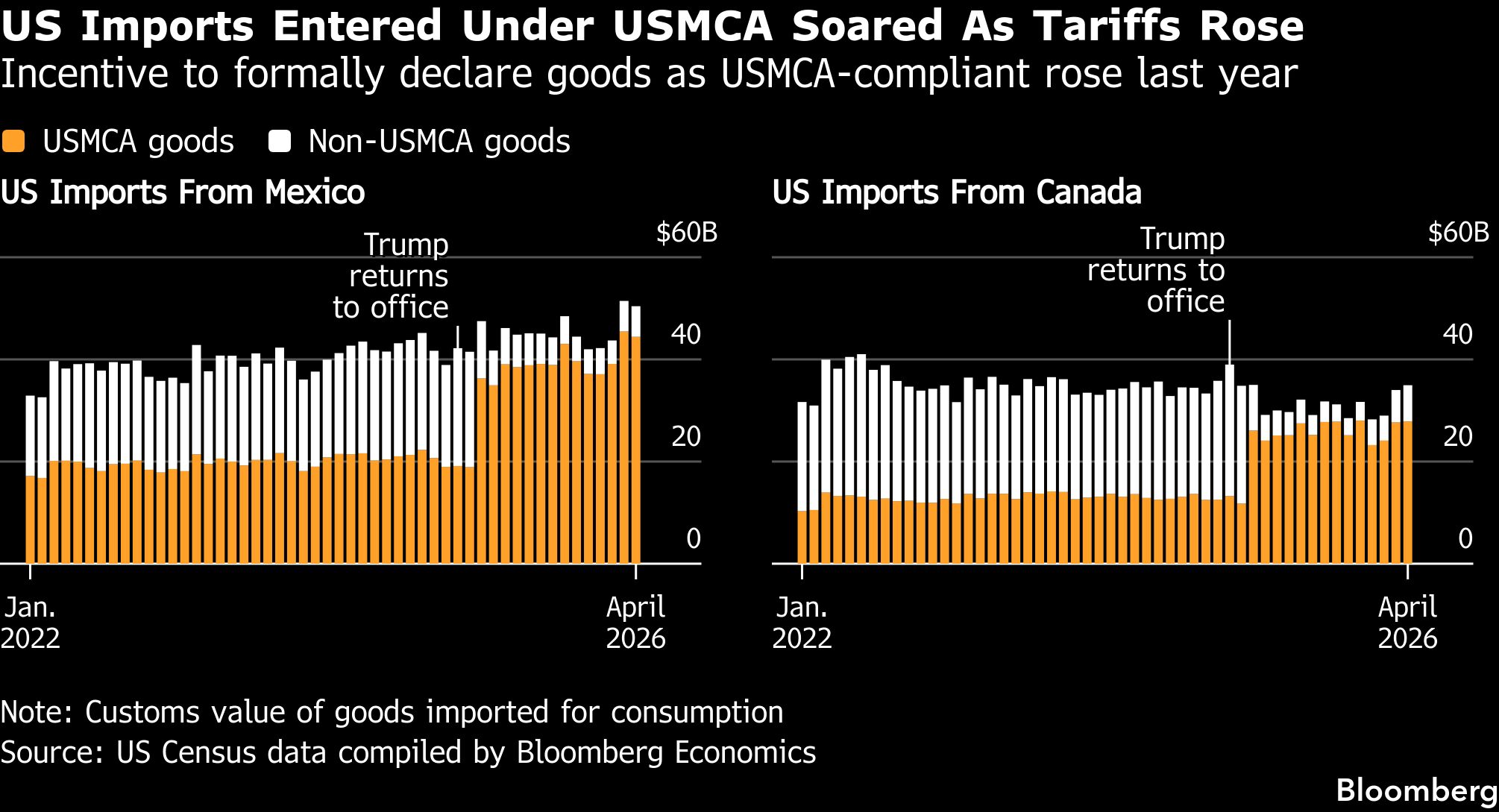
The decision not to renew the deal and instead shift to rolling negotiations means Trump can leverage an “implicit threat of roughly doubling tariffs on Mexico and Canada,” Bloomberg Economics’ Nicole Gorton-Caratelli and Maeva Cousin wrote. Use of the program jumped last year, when new tariffs created a stronger incentive to file the paperwork, and roughly 90% of imports from Canada and Mexico are now recorded as USMCA compliant.
Still, other US duties on products such as autos and metals remain a sore spot and will cloud future talks.
Trump sought to ramp up pressure ahead of July 1, claiming that the U.S. would be better off without the deal. That path will be difficult given bipartisan support for USMCA in Congress, even if some lawmakers and labor unions want to see it improved.
Under the annual reviews, the countries can try to reach an agreement during the next 10 years. If no resolution is reached during that span, the pact expires in 2036.
“We have these ongoing negotiations and we don’t know exactly when they will end, and there’s no short- or medium-term forcing function for those negotiations to end,” said Patrick Childress, co-lead for Holland & Knight’s USMCA team. “So that creates, of course, some uncertainty for companies.”
Washington has already engaged in formal talks with Mexico in recent months but has largely shunned Canada at the negotiating table. Trump has clashed with Prime Minister Mark Carney, who has sought to reduce Canada’s trade dependence on the US.
U.S. and Mexican negotiators will discuss rules of origin for industrial goods that go beyond the automotive sector when they meet for a third time during the week of July 20, according to a senior administration official who spoke to reporters after the official announcement. The talks may also cover aerospace, intellectual property and water quality, the official said.
Complicating any negotiations is China’s more assertive trade posture. As Chinese automakers gain market share outside the U.S., critical USMCA issues include a minimum threshold requirement for American auto parts and a push by Washington to tighten the rules of origin on autos, prompted by concerns over transshipments of Chinese inputs.
‘Mixed Messages’
Another potential flashpoint is the tolerance for Chinese investment, and the degree to which Mexico and Canada align with the US’s national-security concerns about it.
“Canada is interesting because one day they’ll say, ‘We want to help America reindustrialize. We want to help make America great again,’ Greer told Bloomberg News. “Then the next day they’ll talk about bringing in Chinese investment. So we get mixed messages from Canada.”
Given the geopolitical backdrop and Trump’s maximum-leverage style, an extended negotiating process could prompt companies to hold off on potential investments. Lobbying groups including the US Chamber of Commerce and the Business Roundtable have pushed for governments to strengthen and retain the agreement.
“Supply chains are built with 30-year visibility, not five, and uncertainty could dissuade investment and growth,” Madeline Chalecki, assistant director of the Atlantic Council’s GeoEconomics Center, wrote in an online post this week.
After the announcement Wednesday, US trade associations for automakers including General Motors Co. and Toyota Motor Corp., parts suppliers and dealers called on the countries’ leaders to extend the trilateral pact, crediting it with supporting billions of dollars in US vehicle production investment and thousands of manufacturing jobs.
“We urge the leaders of the U.S., Canada, and Mexico to swiftly reach consensus on an extension of USMCA that preserves the existing trilateral partnership” and returns the preferential treatment for qualifying goods, groups including the Alliance for Automotive Innovation and the National Automobile Dealers Association said in a joint statement.
Unions, Retailers
In June, the U.S. Chamber of Commerce brought over 70 business partners to Capitol Hill, pressing lawmakers to “support maintaining the framework, press for full compliance from all three governments and encourage an expeditious and orderly review that delivers certainty for businesses.”
The Retail Industry Leaders Association, whose members include Home Depot Inc. and Target Corp., urged the parties to preserve the duty-free benefits of the deal and reduce uncertainty surrounding the review period as much as possible.
“USMCA provides the certainty retailers need to plan supply chains, invest in North America, and keep goods moving efficiently for consumers,” RILA director of government affairs Ellen Jackson said in a statement.
The International Association of Machinists and Aerospace Workers urged member countries to use the review period to toughen labor standards, strengthen enforcement and improve rules of origin. The pact should do better to “discourage corporations from moving jobs out of the United States and Canada in pursuit of cheaper labor,” the union said in a statement Wednesday.
Top photo: Tractor trailers at the Ysleta-Zaragoza International Bridge port of entry, on the US-Mexico border in Juarez, Chihuahua state, Mexico. Bloomberg.