Don’t Sweat the Heatwave, El Niño Is Cooking up Some Raucous Weather for California
Most of the attention on California’s weather is focused right now on an unusual October heat wave with triple-digit temperatures in some areas, but talk of “atmospheric rivers” bringing crashing waves, pounding rain and snow by the feet to the mountains may soon take center stage.
Warnings are mounting as El Niño conditions strengthen based on oceanic and atmospheric observations, and NOAA is reporting a greater than 90% chance of a very strong event this fall and winter, with a seasonal outlook that favors above-normal precipitation across Southern California.
AccuWeather released its 2026-2027 United States Winter Forecast on Wednesday, which predicts that “a very strong El Niño may reach historic levels in December or January and will be a major influence through winter and into early spring 2027.”
Related: California’s El Niño Emergency Begins Now as Beaches Erode
AccuWeather meteorologists say it has the potential to be the strongest El Niño since 1950. They expect an active southern storm track and warmer conditions across much of the northern United States.
“A potentially historic El Niño is expected to shape this winter, increasing flooding risks across parts of the West and South while favoring warmer, less snowy conditions across much of the northern U.S. Heavy mountain snow in the West could help water supplies, while significant winter storms can still occur in areas forecast to receive less seasonal snowfall overall,” the forecast states.
The latest development for California is a Kelvin wave heading toward the coast, expected to push sea levels up off Southern California by half a foot or more. The levels are expected to remain elevated for months.
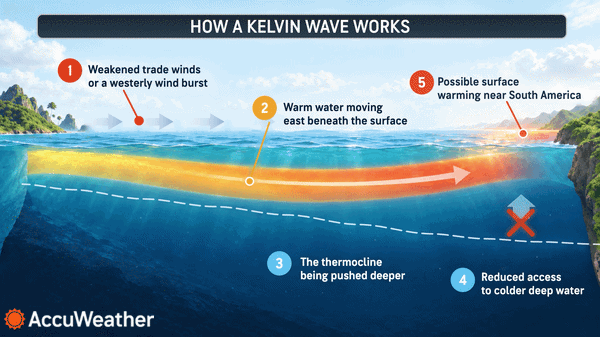
A Kelvin wave is an east-moving warm water pulse along the equatorial Pacific that can help an El Niño develop or strengthen. As the wave moves east, it deepens the warm upper layer of the ocean.
The increased energy comes as sea levels have already risen by several inches in some spots, and AccuWeather forecasts sea levels to rise 3 inches to 6 inches above the historical average across California during October.
Alarms are already being raised. California Gov. Gavin Newsom declared a state of emergency, mobilizing state resources ahead of potential winter storms and other impacts. The Sept. 21 order directs the California Office of Emergency Services to coordinate efforts between state and local partners, as well as to begin advance planning efforts and identify potential needs before impacts occur.
The storm warnings are a contrast with the ongoing Southern California heatwave, which began on Oct. 2, and is forecast to last through Friday. The unusual heat spread across the region, including San Diego, which hit 105° Saturday, the first time the city has reached 100° in October since 1987, according to AccuWeather.
Related: El Niño and Heat Fuel Destructive Storms Across Pacific Ocean
Temperatures across the Los Angeles area are expected to stay 15 to 25 degrees Fahrenheit above the historical average through Friday, AccuWeather forecasts.
But Paul Pastelok, meteorologist, isn’t dwelling on the heat.
“El Niño is probably going to be one of the more dominant signals that we see this winter season,” said Pastelok, senior meteorologist/lead U.S. long range forecaster at AccuWeather. “It’s going to probably be almost at record levels, and so it’s going to have probably a major influence here on the West Coast, especially as we go through the course of the winter season, even including the late fall and in early spring…so, this could be a five-month, at least, situation that we’re setting up here.”
That situation for California includes the likelihood of atmospheric rivers dumping moisture on the state over short periods.
“They’re very strong, very moist systems that come into the West Coast and they can provide very, very heavy rain, flooding rains and heavy mountain snows,” Pastelok said. “And so, the setup this year is looking at the water temperatures, looking at a strong very strong El Niño, kind of leans towards California getting hit pretty hard.”
What remains uncertain is whether or how often these storms will reach down into the lower portions of the state, leaving Southern California wetter or drier, or most of the storms will be stay in Central to Northern California.
Based on the data he’s seeing so far, Pastelok believes Central California into the Sierra Nevada Mountains are poised to get hit hard consistently with heavy moisture.
Massive media coverage about a looming El Niño hasn’t done much to influence flood policy buying in the state. According to a spokesperson with the National Flood Insurance Program, active policies in California decreased by 5% over the past year, though the rate of monthly decline slowed over the summer. That could soon change. “Historically, the occurrence or absence of large storms in a particular area has influenced decisions to purchase flood insurance,” the spokesman said.
AccuWeather’s forecast expects an active southern storm track is forecast to bring “persistent wet conditions from the southern Plains through the Southeast and mid-Atlantic,” with repeated that rainfall could raise river levels by late winter, and some storms potentially producing severe thunderstorms and tornadoes.
Strong coastal storms during late winter could increase the risk of coastal flooding and erosion along the East Coast. River flooding could be an increasing concern as winter progresses, particularly across the lower Mississippi and Tennessee valleys, where river levels could rise. Rivers may also rise sharply across parts of the Southeast and lower mid-Atlantic, according to the report.
“Above-average temperatures and fewer Arctic outbreaks are forecast across much of the northern United States,” the report states. “AccuWeather’s outlook puts winter temperatures 3-4 degrees above average in Chicago, Detroit, and Minneapolis. Forecast heating degree days for October 2026 through March 2027 are below historical averages in several northern cities, indicating lower weather-driven heating demand. Comparisons with last winter vary by location.”
- Judge Rules UnitedHealth Must Face Shareholder Suit by CalPERS
- Warren, Hawley Press Insurers Over Closed, Unpaid Claims
- EU’s Insurance Watchdog Warns of Risks Tied to Extreme Heat
- Before the Nuclear Verdict: Rethinking How Liability Claims Are Managed
- The Nation’s Insurance Laboratory: What Liability Trends in California Mean for the Rest of the Country
- New Corgi, Liberate, VERVE Claims Tech. Do We Need New Acronyms?
- Are We Training Claims Adjusters or Claims Processors?
- The Great Hemp Reset: How the Federal Ban on Intoxicating Hemp Products Will Reshape Risk and Coverage