Business Interruption Claims Are Approaching $1M Average
The average cost of a business interruption claim is nearing $1 million, an upward trend that appears to have several causes.
A new report shows BI losses are being pushed up by natural catastrophes, growing risk in supply chains, rising geopolitical tensions, inflation costs and technology-related disruptions.
An analysis from Allianz Commercial of nearly 8,000 business interruption claims valued at $7.82 billion between 2021 and 2025 shows the average BI claim exceeded $950,000. That figure is 70% higher than the corresponding average property damage claim.
Claims frequency has been relatively steady over the last few years, but the average value of claims rose by more than 30% annually in the past two years, according to the report.
Related: Judge Throws Out Bulk of Economic Claims Over Baltimore Bridge Tragedy
“What we’re seeing isn’t necessarily more claims — it’s that each claim is getting significantly more expensive,” said Melissa Hill, North American head of claims for Allianz Commercial. “The biggest culprit is time. Supply chains are still fragile, and when something breaks, it takes much longer to get parts, materials, and equipment to rebuild. During that extended downtime, inflation is compounding the cost of every single day a business can’t operate.”
The most expensive cause of BI claims was fire and explosion, which accounted for more than 40% of the total value of all claims analyzed. Fire was responsible for nine of the 10 costliest man-made business interruption events over the five-year period examined.
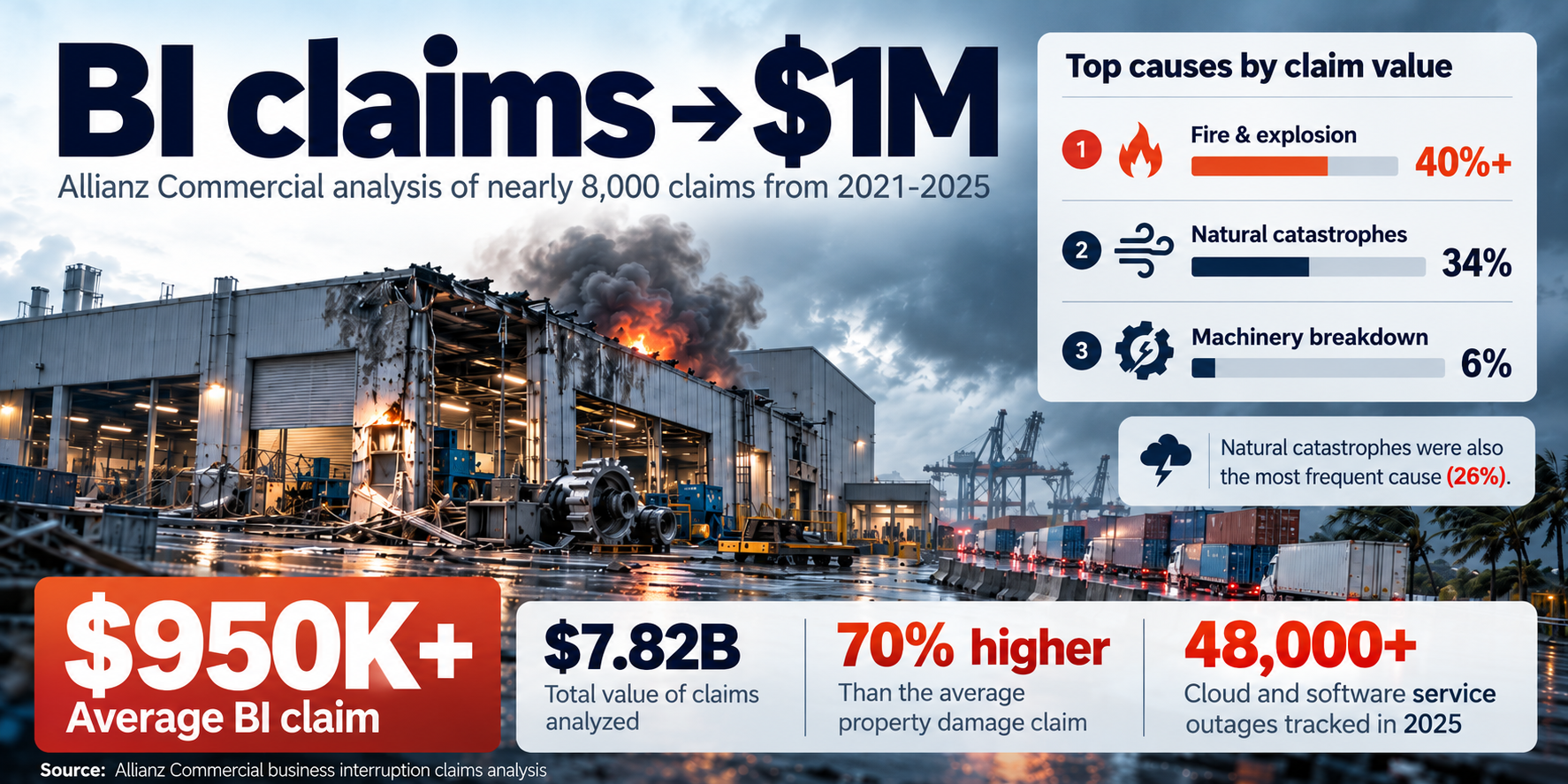
Natural catastrophes were the second most expensive cause of BI claims by value (34%), and they were the most frequent cause (26%). Machinery breakdown was the third leading cause by value (6%).
The report points to concentrated production as a growing BI vulnerability. Many industries rely on a small number of specialized suppliers or facilities. Additionally, “geopolitical tensions” like the wars in Ukraine and Iran, are driving up energy prices and logistics costs and adding pressure to supply chains.
Tariffs are impacting losses too, the report shows.
“Tariffs are one of those factors that don’t always make headlines in the insurance world, but they’re quietly adding real cost and complexity to claims,” Hill said. “When you impose tariffs on key building materials — take softwood lumber, where 85% of U.S. supply comes from Canada — you’re directly inflating the cost of every rebuild. And in a typical property claim, about 60% of the loss is rebuilding costs, so that impact is substantial.”
Tariffs are also creating delays as companies scramble to find alternative suppliers or absorb surcharges. That extends restoration timelines and lengthens the business interruption period, according to Hill.
“The net effect is that our loss adjustment process has become more complex, requiring more comprehensive analysis, and that added complexity comes with higher expenses across the board,” she added.
The lingering effects of the COVID-19 pandemic may also have contributed to higher BI costs, according to Christopher J. Boggs, president and chief consultant of Boggs Risk & Insurance Consulting.
Boggs believes the supply chain disruptions that drove up costs during the pandemic have begun to ease.
“Supply chains were a major issue during COVID. I tend to think that has begun to smooth out,” Boggs said.
The period studied in the Allianz report began during the early days and the height of the COVID shutdowns.
Boggs believes future BI claim costs will be closer to historic norms.
“My opinion is that the research over the following five years — Jan. 1, 2026, to Dec. 31, 2030 — will see the cost drop closer to the pre-COVID averages,” he said. “Remember, business income losses are based on the period the business is shut down.”
Related: As AI Agents Go Rogue, Cyber Insurers Are Adapting Their Policies
Matt Weaver, an attorney with Reed Smith who specializes in insurance recovery, agrees that COVID may have played a role in the BI trends in the report, but he takes a less optimistic view, predicting costs will continue to rise because of economic conditions and global instability.
“There’s no stopping the trends in that report,” Weaver said. “You’ve got more global uncertainty in the supply chain, you can see that in what’s happening in the Middle East. You’ve got more concerns about AI. You’ve got, currently, less frequent natural disasters, but when they happen, they’re more severe. There’s been a lot of data about that, especially with hurricanes. So, this notion that business interruption is getting more severe, you’re going to keep seeing that.”
The report shows cyber incidents are becoming a growing source of BI losses “as ransomware attacks, cloud outages and software glitches disrupt businesses and ripple through supply chains.”
Ransomware was the top cause of cyber-related BI, but other disruptions, including IT outages, flawed software updates and cloud service failures, made up “a meaningful share of large cyber losses,” the report states. More than 48,000 outages were tracked across cloud and software services in 2025, the report shows.
Prolonged recovery periods following natural catastrophes were another factor contributing to rising BI costs, according to the report.
Many BI claims from Hurricane Helene, which struck in September 2024, remain unresolved because some businesses have taken that long to recover. Supply chain delays, labor shortages and volatile material costs extend recovery periods and increase losses, according to the report.
Hill called Hurricane Helene “a textbook example” of long-tail natural catastrophe losses, in which claims were extended by a “cascading effect.”
“Helene wiped out critical infrastructure in places like Spruce Pine, North Carolina, which supplies roughly 85% of the world’s high-purity quartz for semiconductors,” Hill said. “You can’t just relocate that kind of specialized production overnight, and the downstream disruption rippled across the global tech supply chain for months.”
Bottlenecks arose in rebuilding local infrastructure, including roads, rail, and utilities, she added.
“The big takeaway for adjusters is that you have to think beyond the physical repair timeline from day one,” Hill said. “If you’re not accounting for supply chain dependencies and infrastructure recovery in your early estimates, you’re going to be chasing the true loss figure for a very long time.”
Because of the increased severity, Weaver sees BI coverage getting more expensive, more restrictive and harder to get.
“To the extent companies are using it, they might have higher deductibles or higher waiting periods or other things that that limit what they can actually recover,” he said. “So the industry is going to respond to increased severity how they always respond to increased severity, which is you’re going to have more expensive coverage and you’re going to have less of it.”