Walter’s Insurers Skirted Capital Rules With ‘Rolling’ Loophole
On paper, it was supposed to be a six-month loan. In December 2018, one of sports mogul Mark Walter’s insurance companies sent $40 million to an undisclosed borrower.
But rather than collect payment when the loan matured the following June, Delaware Life Insurance Co. rolled the debt into another six-month loan – and then another, and another. As of last December, the insurer still hadn’t collected the debt, one of dozens of “short-term” financings that have lingered for years.
Related: Warren Presses Insurance Watchdogs for Answers Amid Walter Probe
The rollovers are part of an accounting maneuver that helped Walter’s insurance companies sidestep regulations while directing billions to his other businesses, according to a Bloomberg analysis of the holdings and a person with knowledge of the strategy, who asked not to be identified discussing confidential information. The move helped them reduce their required risk-based capital – the minimum cushion they must hold against the chance investments sour.
The insurers now face parallel inquiries from the US Department of Justice and the Securities and Exchange Commission, focused on their failure to disclose that more than $20 billion of loans had gone to affiliates, including the 2018 deal. The lapse raised new questions about capital management and prompted ratings firms to lower their outlook on the companies’ financial strength.
The insurers’ handling of short-term assets is “a red flag for the regulators, the rating agencies, for the policyholders and the agents selling the product,” said Alton Cogert of Strategic Asset Alliance, an investment consultant in Bellevue, Washington. “Our friends on Wall Street are really good at looking at those rules and saying, ‘How do we get extra juice?'”
Group 1001, the parent company through which Walter owns Delaware Life and sister firm Clear Spring Life and Annuity Co., declined to comment. It has said its capital position remains strong and that it plans to sharply reduce its holdings of affiliated assets, including short-term investments, by year-end.
Walter, the owner of Major League Baseball’s Los Angeles Dodgers, did not respond to a request for comment sent to his TWG Global holding company.
As chief executive officer of Guggenheim Partners, Walter helped pioneer Wall Street’s takeover of the life insurance industry in the wake of the 2008 financial crisis. He and other new entrants pushed insurers into more opaque and illiquid private credit assets, boosting returns while exposing the industry to new risks.
Policymakers have known about the potential of “rolling” short-term investments to sidestep capital rules since at least 2019. That was when staffers at the National Association of Insurance Commissioners, the nonprofit that helps set policy for state regulators, pointed out that insurers could get better capital treatment by disguising risky long-term investments as short-term ones.
For volatile long-term investments, such as stock or unrated loans, capital rules can require insurers to set aside 30% to guard against potential losses. But for certain short-term investments, the charge can be as low as 0.39%, no matter how risky the asset. That’s more favorable than investment-grade corporate bonds issued by the likes of Procter & Gamble Co. or Walmart Inc.
NAIC staffers drafted a rule change that would impose steeper capital charges on short-term debts that rolled repeatedly. But it didn’t apply to reverse-repurchase transactions, the kind of debt Walter’s insurance companies used most frequently for the strategy. And after pushback from the industry, an NAIC working group adopted a narrower version of the measure that applies in even fewer situations.
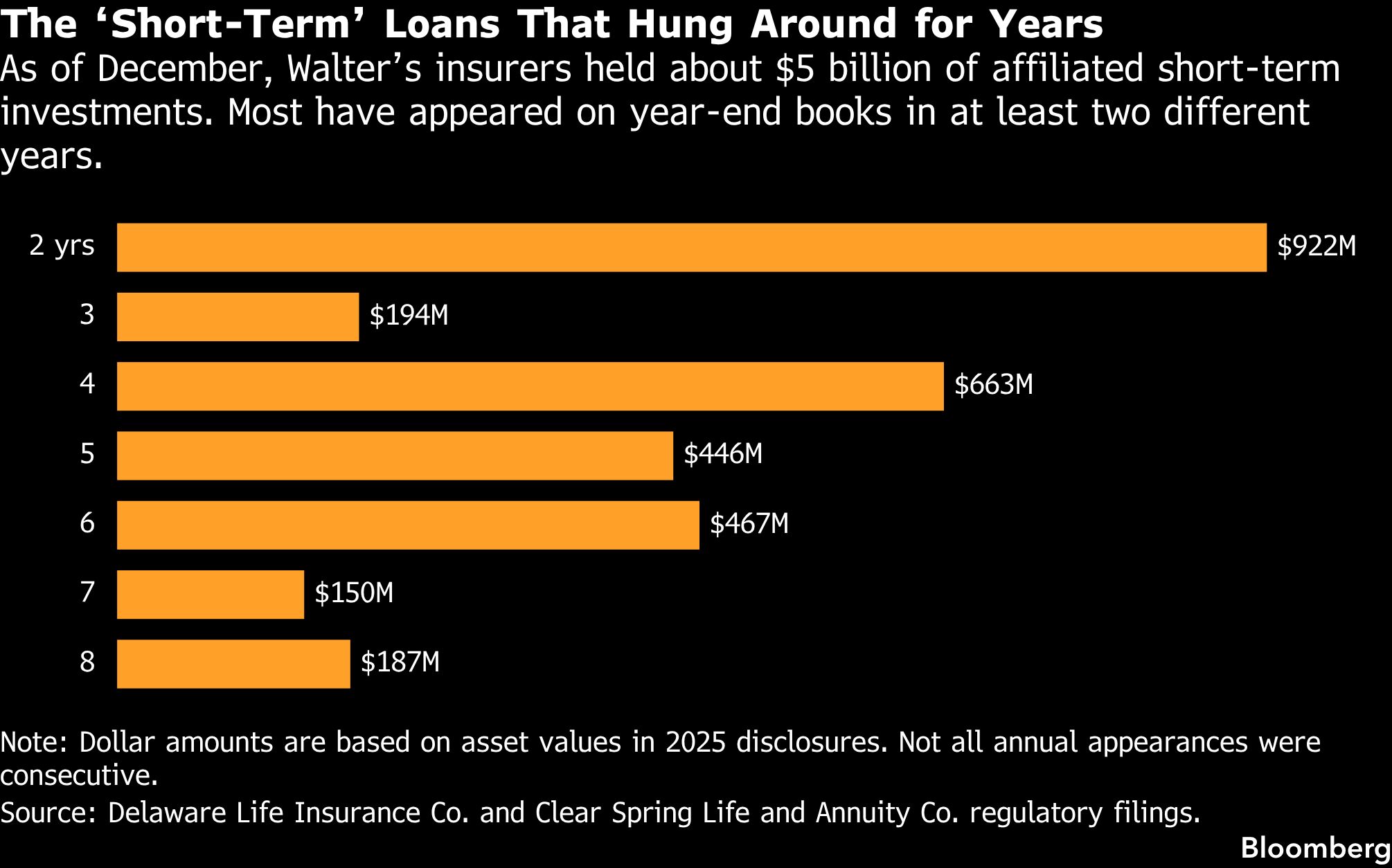
In recent years, the amount of money Walter’s insurers devoted to the strategy ballooned. By 2025, the companies held $5 billion of short-term investments, or about 9% of total invested assets – among the largest proportions of any US insurance group. The industry average is less than 1%.
It’s not unusual for insurers to exploit accounting loopholes, said Tom Gober, a former Mississippi insurance examiner and a critic of industry risk-taking.
But “this one I had not encountered before, because I don’t look at short-term investments that often,” he said. “You’d think there wouldn’t be any hanky panky there.”
The ‘Short-Term’ Loans That Hung Around for Years | As of December, Walter’s insurers held about $5 billion of affiliated short-term investments. Most have appeared on year-end books in at least two different years.
Virtually all of the short-term assets are loans to firms controlled by Walter, typically through limited-liability companies with no public profile, according to Bloomberg’s analysis of the holdings. About $2.3 billion of the total had simply been rolled from loans involving the same LLCs in the previous year. Some of it dated back almost a decade.
The insurers don’t have to report the nature of the investments or how risky they are. If the full $2.3 billion of assets that rolled between 2024 and 2025 were the riskier types, the strategy could have reduced risk-based capital requirements by more than $600 million, compared with booking them as long-term assets. Companies that free up extra capital can use the money to expand or to pay dividends to their owners, among other things.
The rolling strategy was used to get lower capital charges for assets that might not be able to secure an investment-grade credit rating, or any rating at all, according to the person with knowledge of the matter.
The interest rates Walter’s insurers earned on the short-term debt fluctuated from year to year, showing that the terms weren’t automatically renewed every time the debt rolled over. In 2025, the payouts ranged from 6% to 9% annualized.
Among the longest-lived “short-term” assets was that $40 million loan from 2018. It was a reverse repurchase, meaning Delaware Life handed over cash in exchange for collateral, which the borrower agreed to repurchase with interest at the end of the term. The collateral for this loan was a shell company called Erikson AH LLC.
Little is publicly known about Erikson. A document on file in the Delaware Secretary of State shows it was formed in 2016 by a lawyer in Walter’s family office. Despite the connection, Delaware Life reported for years that Erikson wasn’t affiliated – meaning it wasn’t controlled by Walter.
Only after it received a subpoena from federal prosecutors this year did the company acknowledge that virtually all of its short-term assets are indeed affiliated with Walter, including Erikson.
Top photo: SEC headquarters in Washington. Bloomberg.
- Recovery Starts Before the Loss: What Claims Professionals Know About Severe Weather Preparedness
- Tesla Launches Roadster at SpaceX Site in Latest Merger Hint
- Burned by Fire, Malibu’s Million-Dollar Mansions Face a New Threat: El Niño
- Apple-OpenAI Judge Says He’s ‘Likely’ to Side With iPhone Maker