Tesla to Phase Out Cybertruck After Years of Poor Sales
Tesla Inc. is discontinuing the Cybertruck, the polarizing pickup that turned plenty of heads in its brief time on the market but never sold anywhere near Elon Musk’s lofty predictions.
Production will wind down at Tesla’s Texas plant in the middle of next year to free up capacity for the Cybercab autonomous vehicle, Musk said Friday in a social-media post that didn’t offer further details. The chief executive officer confirmed the cancellation in a subsequent post on X in which he said he still expected a fleet of Cybertrucks to be around “for a long time.”
Tesla will be winding down production of the Cybertruck at Gigafactory Texas around the middle of next year to make room for increased Cybercab production
— Elon Musk (@elonmusk) November 6, 2026
The abrupt announcement amounts to a death knell for the divisive electric truck, which fell well short of demand projections and suffered a series of recalls. Bloomberg News reported earlier this year that sales had been propped up by purchases from Musk’s other companies, particularly SpaceX.
The phase-out in part reflects the Cybertruck’s “relatively limited commercial success,” Barclays analyst Dan Levy said in a note. Tesla is making about 20,000 of the pickups a year, roughly 1% of the company’s total volume and a fraction of the more than 125,000 that the factory is capable of producing, he said.
The angular and unconventional vehicle divided opinion as soon as Musk unveiled a prototype in 2019. Tesla’s chief designer threw a metal ball at its supposedly shatter-proof window on stage, only for the glass to break.
Tesla began building Cybertrucks at its factory near Austin in 2023, when Musk estimated Tesla might make more than 250,000 annually, depending on demand. The company sold less than one-sixth that number in its first year. Musk nevertheless extolled the pickup earlier this year as “the best vehicle Tesla has ever made.”
Wes Morrill, Tesla’s lead Cybertruck engineer, thanked buyers and Tesla workers in a post Friday on X, saying the model “was an incredible technology development platform and lives on through Cybercab.”
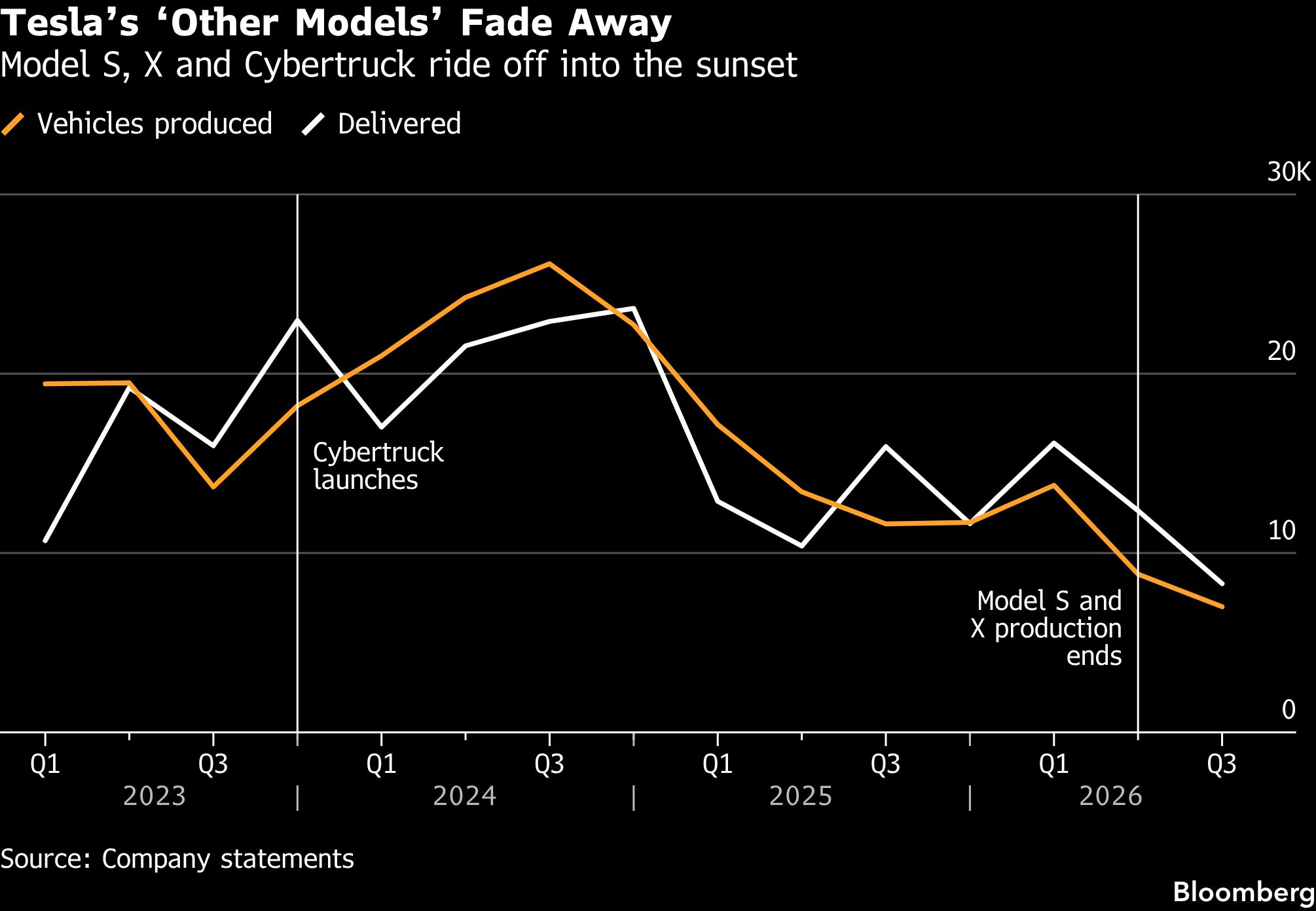
Killing the Cybertruck extends a trend in which Tesla prunes the more expensive and slower-selling models from its already-slim lineup. The automaker discontinued its pricey Model S and X vehicles earlier this year. The vast majority of its sales come from the Model Y SUV and Model 3 sedan.
Last quarter, Tesla reported that it sold 8,295 “other models,” most of which likely were Cybertrucks. That was down sharply from a year ago, when the US still offered a federal EV tax credit and when the now-discontinued Model S and Model X were included in the category.
Tesla shares rose 3.1% as of 9:50 a.m. in New York, rebounding modestly from declines following the US midterm elections.
Tesla has been deemphasizing its core auto business in recent quarters, and investors have largely looked past sales results as Musk works to refocus on futuristic business lines including AI, robotics and autonomous vehicles. Central to that effort is the Cybercab, a two-seat car with no steering wheel or foot pedals.
The company began producing Cybercabs at the Austin factory this year and recently rolled it out for the public through Tesla’s robotaxi service. The car already is under scrutiny: U.S. auto-safety regulators are probing the process and technical data Tesla relied on when the company self-certified the vehicles as compliant with all federal safety standards.
Top photo: Tesla Cybertrucks outside a SpaceX facility in Starbase, Texas. Photographer: Ronaldo Schemidt/AFP/Getty Images. Bloomberg.
- 3M Commits Nearly $7.4 Billion to Settle PFAS-Related Claims
- Binance Hackers Used Fake Job Interviews in $6.3 Billion Heist
- Miami Beach Buildings Sinking at Different Rates, Due to Construction, Study Finds
- As AI Laws Proliferate, Liability and Coverage Questions Multiply