Probe of Mark Walter’s Insurers Spotlights Gaps in Regulatory Patchwork
Trinidad Navarro knows how to hunt down wrongdoing.
That was his pitch when Delaware voters picked the longtime police officer and sheriff to become their state’s insurance commissioner, drawn to his pledge to hold companies accountable.
But in the decade that followed, his office missed what’s now the industry’s most high-profile scandal: Federal probes centered on a pair of life insurers owned by billionaire sports mogul Mark Walter that call the state their home.
It’s among a spate of flareups raising concerns that the U.S. approach to regulating life insurers is failing to keep pace with the industry’s rapid evolution. Private equity firms are snapping up insurance companies — adding about 50 since the pandemic, according to one regulator’s tally. Many are making bets far beyond traditional bonds, buying complex or risky assets, some through opaque channels or offshore.
Related: Insurance Regulators Defend State-Led Model in Reply to Warren
The daunting work of keeping policyholders safe rests with state insurance commissioners facing pressure to both police insurers and attract them into their jurisdictions to provide jobs and boost tax collections. In 11 states, the watchdogs are elected, giving deep-pocketed industry players an opening to spend on campaigns and help pick who oversees their business.
Critics say that’s setting off a regulatory race to the bottom. Amid rising sales of life insurance and annuities, some watchdogs are easing oversight or loosening rules. Even those vowing to stay vigilant are getting stretched thinner.
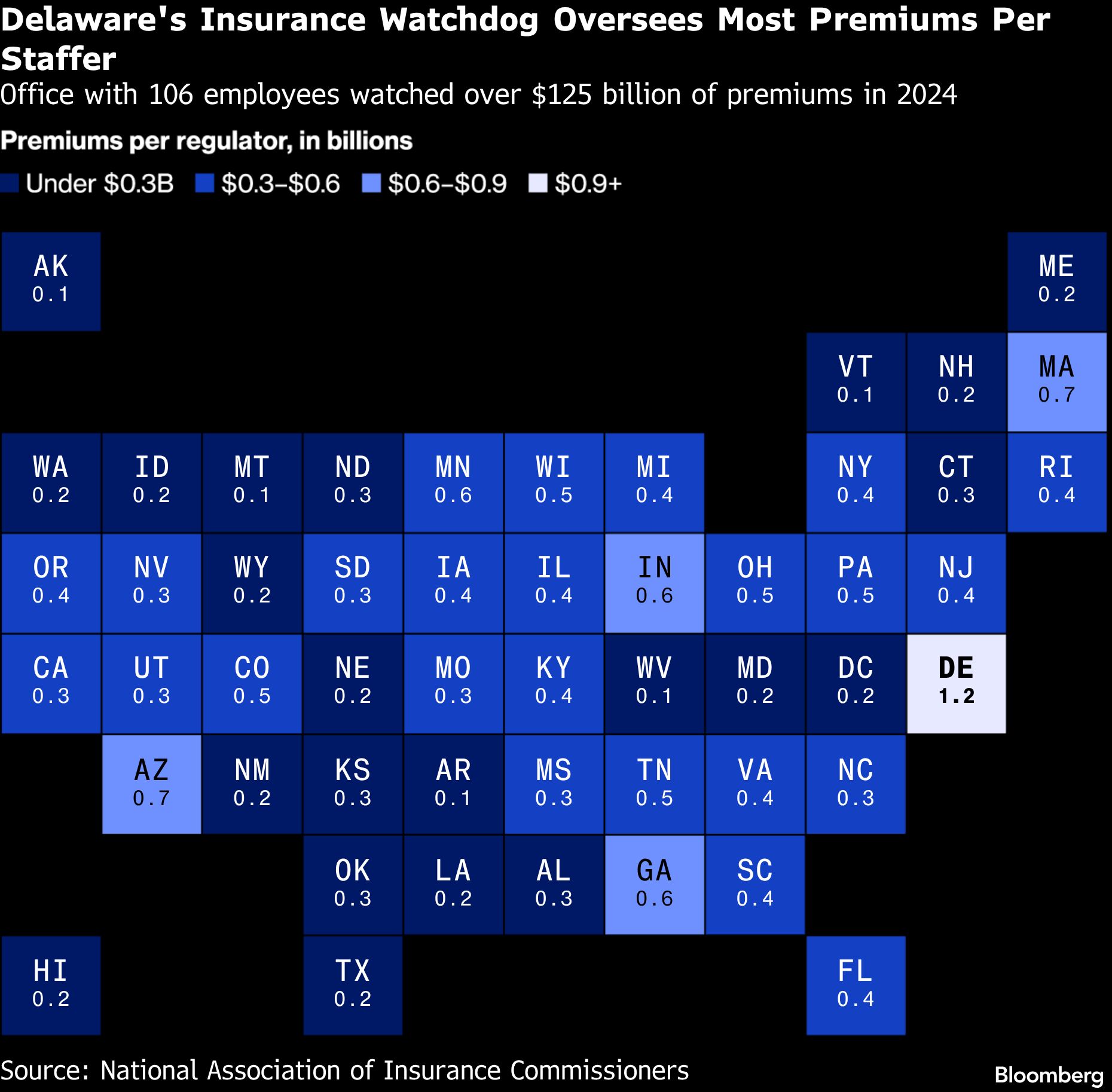
Navarro’s office stands out. It’s now in charge of overseeing more life insurance premiums per staffer — about $1.2 billion — than any other state regulator.
The same office is in charge of scrutinizing Aquarian Holdings founder Rudy Sahay’s $4.1 billion bid to buy life insurer Brighthouse Financial Inc. — a deal that has been delayed as the regulator digs into his sources of capital.
Meanwhile, the probe of Walter’s Delaware-based insurers is being led by a team of federal prosecutors more than 100 miles northeast of the state. They’re digging into why two of his firms — Delaware Life Insurance Co. and Clear Spring Life and Annuity Co. — failed to disclose that more than $20 billion of their investments went to entities that finance the mogul’s other ventures.
Lending to affiliates isn’t banned but must be disclosed — something they didn’t do until after the Justice Department sent subpoenas asking questions.
The revelation has raised alarms among regulatory experts: If insurance watchdogs weren’t tracking how much the owner of the Los Angeles Dodgers and Lakers leaned on policyholders’ life savings, then what else are states overlooking?
“I don’t know what the Delaware regulators were doing,” Daniel Schwarcz, a law professor at the University of Minnesota who focuses on insurance law, said in an interview. “This should have been on their radar for a long time.”
A representative for Navarro’s office had no comment. Investigators haven’t accused Walter or his businesses of wrongdoing. His TWG Global holding company has said “there is no victim here. No one has been harmed, and no one has claimed they were harmed.”
It’s not the only situation stoking concerns.
In Connecticut, watchdogs have been dealing for the past couple of years with a multibillion-dollar shortfall at PHL Variable Insurance Co. Before the full extent of those problems emerged, the insurance and annuity provider had its balance sheet reshaped under the stewardship of private equity firm Golden Gate Capital — after obtaining regulatory approvals.
In South Carolina, authorities recently sought to take control of a pair of insurers from Advantage Capital Holdings, alleging they were in a “financially hazardous” position because of troubled investments. That case actually marks the regulator’s second attempt to intervene — based on new information — after a judge last year overturned an earlier order barring the insurers from writing new business, disputing the state’s findings that they were in distress.
Bloomberg reported last week that other insurance firms run by Walter’s longtime business associates loaned a significant chunk of their portfolios — about $21 billion — to companies that appear to serve as Walter financial conduits.
While those arrangements may be legal, and don’t mean that all of the money ended up with him or his companies, it adds to what’s known about his financing from insurers.
The probe of his empire has set off an unusual range of critics, including billionaire Marc Rowan and U.S. Senator Elizabeth Warren.
Rowan, who leads Apollo Global Management Inc. and its massive Athene annuities and insurance arm, told a conference recently that the degree to which Walter’s firms have been able to plow policyholder money into affiliates is undermining public confidence in the sector.
“We should be financial giants striding the globe. Instead we are dealing with the potential loss of trust,” Rowan said of the industry. “Loss of trust comes from regulatory arbitrage. It also comes from allowing situations like have happened with Delaware Life.”
Warren, a Massachusetts Democrat who’s poised to become chair of the Senate Banking Committee in January, suggested U.S. lawmakers need to get more involved.
“Congress needs to understand the current regulatory gaps,” she wrote in a letter to the National Association of Insurance Commissioners, which coordinates standards for state watchdogs. And U.S. policymakers must “better mitigate the risks private credit poses to the insurance markets and policyholders.”
Assailing US Oversight
That message is likely to rile up state regulators, who have vociferously rebuffed federal oversight in the eight decades since Congress granted them sole authority over the industry. They’ve sought to create a national framework through the nonprofit NAIC.
Some states have tried to do away with even minimal oversight from the federal government.
In 2024, a group of nine state regulators publicly called on Elon Musk and Vivek Ramaswamy, who were expected to lead the Department of Government Efficiency, to abolish the small Federal Insurance Office.
The watchdogs argued in a letter that the unit, which monitors the industry for the Treasury Department, was ineffective and they took issue with its collection of data.
The NAIC later joined efforts to shut it down, saying the office’s existence creates confusion about who has authority. The FIO remains.
Jurisdiction Shopping
State regulators are confronting some of society’s biggest financial challenges — trying to improve access to health insurance, make sure homebuyers can find coverage in regions increasingly prone to national disasters and help drivers deal with rising prices for policies.
On top of that, they have to make sure that firms selling life insurance and annuities will be around to make good on their obligations decades from now. Concerns about the risks being taken are mounting as more Wall Street firms assume control.
One problem when regulating balance sheets backing those longtime promises, according to critics, is that the companies can change where they call home.
That means “insurers can for most part choose who their regulator is,” said Schwarcz, the professor.
Some insurers have been relatively open about this. Shortly after Apollo’s Athene acquired Liberty Life Insurance Co. in 2011, it changed its domicile to Delaware from South Carolina. Athene’s then-leader Jim Belardi put it simply: “We wanted one regulator. We liked them better.”
Some firms jump domiciles repeatedly.
Shortly after its acquisition by Walter’s Guggenheim, Equitrust moved to Illinois from Iowa. Later, it redomiciled to Arizona, where the regulator permitted it to use an advantageous accounting practice allowed by Iowa law that has burnished net income in recent years. A spokesperson for Arizona’s office declined to comment.
In 2023, SILAC Insurance Co. moved its domicile to Indiana after an examination report from Utah regulators highlighted a variety of reporting errors, including how the firm characterized one of its reinsurers, as well as potential conflict of interest in its investment portfolio.
The agencies either declined to comment or didn’t immediately respond to messages. Indiana regulators later flagged irregularities, too, including the firm’s failure to notify the regulator of dividend payments the company made to its parent.
“There are legitimate reasons to change domicile,” said Tom Gober, a former Mississippi insurance examiner and a critic of industry risk-taking. But in some cases, “it looks like they move from one to the other to avoid regulatory takedown.”
In a statement, the NAIC said it isn’t possible to escape oversight by moving states because all regulators enforce the same core standards. If an insurer does want to change domicile, the move can only proceed if both states review and approve it.
“It is not a mechanism to evade supervision,” the organization said. Moreover, “the state-based system is well suited to adapt alongside and ahead of an evolving marketplace and remains focused on ensuring insurers can meet their promises to policyholders.”
Spokespeople for SILAC and Equitrust, which Guggenheim later divested, didn’t respond to messages seeking comment.
Insurer’s Shortfall
To prevent insurers from decamping, some regulators have been willing to bend rules.
One area of concern relates to state rules governing use of so-called reinsurance captives.
Reinsurance, known as insurance for insurers, helps firms shift risks off their balance sheets to free up capital. In recent decades, more reinsurers set up affiliates to provide that relief. Those arrangements eliminate the outsider perspectives that third-party reinsurers provide. Without the proper checks, they can lead to devastating consequences for firms and their clients.
In Connecticut, the captives set up by PHL are central to its sinking finances. The firm is confronting a capital hole of more than $2 billion and is expected to face liquidation proceedings next year. Clients are still paying premiums, unsure they’ll ever see the promised benefits.
Sometimes, the contortions that a single state regulator is willing to make for one of its domestic insurance firms can eventually end up putting it at loggerheads with counterparts in other states.
Kansas stepped up for billionaire Todd Boehly’s Security Benefit Life Insurance Co. at least a couple of times.
More than a decade ago, the company and its regulator supported a bill to lift a cap on investments in asset-backed securities. The instruments have become essential to the firm’s returns.
“Kansas’s 2014 change to insurers’ investments in asset-backed securities was adopted as part of a bipartisan initiative and without a single dissenting vote in the entire Kansas legislature,” the firm said in a statement.
This year, the state’s insurance regulator successfully lobbied peers to delay new capital rules affecting collateral loans, a relatively unusual type of debt. That was another reprieve for Security Benefit, which is heavily invested in the instruments.
But that time, the regulator’s move irked other states where the firm sells coverage. In a public letter at the time, officials in Iowa called the loans “the most easily exploited asset class for capital arbitrage.”
The episode also put a spotlight on another issue: Some watchdogs have to win election to keep their posts, and some have ambitions for higher office. That has led Mississippi Insurance Commissioner Mike Chaney, first elected in 2007, to call for his role to become appointed.
Only a few weeks before Kansas’ lobbying this year, Boehly and his associates donated about $300,000 to the gubernatorial campaign of its insurance commissioner, Vicki Schmidt. Boehly’s main holding company, Eldridge Industries, has said the firm and its affiliates “invest in leaders we believe in.”
Schmidt didn’t respond to requests for comment. But earlier this year, her campaign said that donations “have no bearing on policy decisions made at the Insurance Department.”
She ended up placing third in the Republican primary for governor and didn’t appear on November’s ballot.
Top photo: Walter and President Donald Trump in 2025. Bloomberg.
- US Airlines Race to Recover From Longest Shutdown in Decades
- Citi Settles Sexual Harassment Claims by Managing Director
- Manufacturers Hammer IBHS Over 15-Year Roof Age Limit for Fortified Designation
- Report: Rising Disaster Risks Threaten Insurance Availability, Home Values