LaGuardia Controllers Often Faced Late Sunday Rush Before Crash
The two air traffic controllers at LaGuardia Airport were grappling with a higher-than-anticipated workload, complicated by foul weather, when an inbound Air Canada Express jet plowed into a fire truck on Sunday evening, killing both pilots.
The heavy, late-evening traffic wasn’t out of the ordinary for LaGuardia, data from aviation analytics company Cirium show. Air crews and controllers consistently face a late-evening rush to clear planes from the busy New York City airport where scheduled flight operations generally cease around midnight.
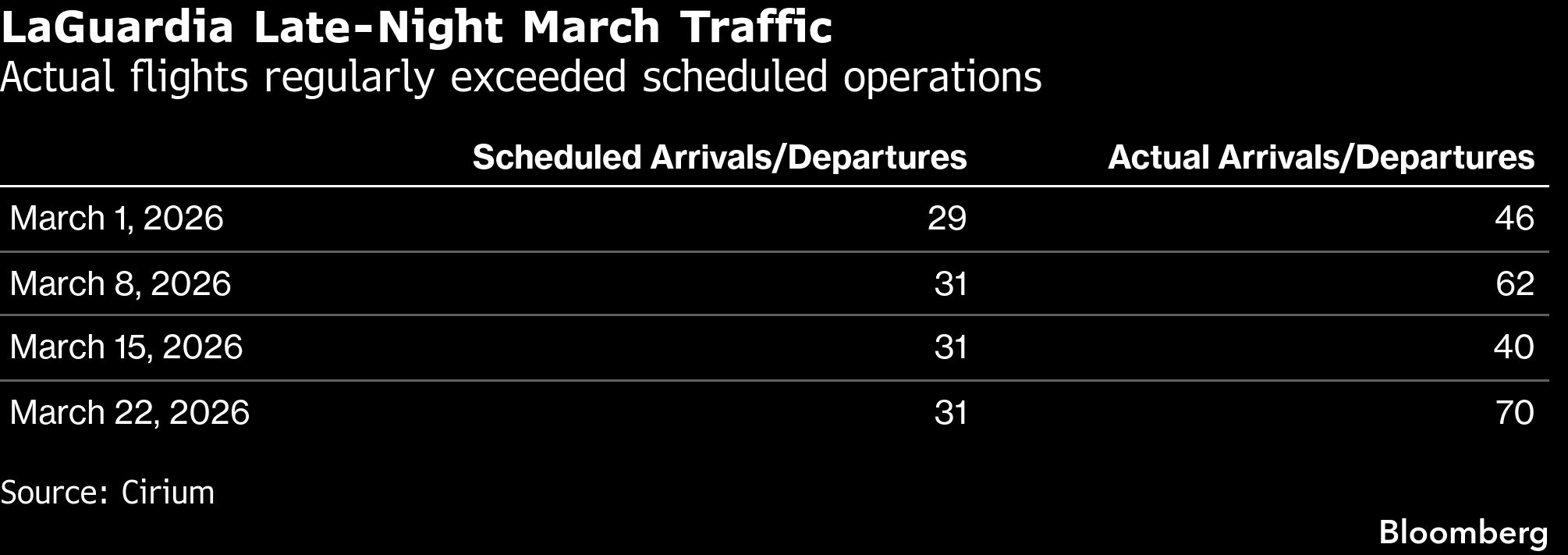
In the stretch between 10 p.m., shortly before the first controller clocked in on Sunday, through the fatal accident at 11:37 p.m., 70 commercial flights landed or took off from LaGuardia. That’s more than double the 31 flights scheduled at the airport during that 97-minute time span, according to Cirium.
Moreover, actual flight activity far exceeded the scheduled operations during the same time period for every Sunday night in March, Cirium data show. On March 8, controllers handled a comparable workload — 62 arrivals and departures during the same time span, with the loads tapering off the other two Sundays.
The flight activity on the night of the crash is another piece of the puzzle as investigators at the US National Transportation Safety Board work to determine why the accident occurred. The tragedy is the latest in a string of fatal US aviation disasters since the start of last year when a commercial passenger jet collided midair with a U.S. Army helicopter, killing 67 people.
It also comes as the U.S. Federal Aviation Administration has been taking steps to curb runway incursions, like the incident at LaGuardia, by deploying new technology at airports.
It’s common practice across the U.S. to reduce staffing during the midnight shift to two controllers, NTSB Chair Jennifer Homendy told reporters Tuesday. The FAA defines the midnight shift as one in which the majority of hours are worked between 10:30 p.m. and 6:30 a.m.
At LaGuardia, the “curfew is at midnight, but the overnight shift actually starts at 10 p.m. or so,” said aviation consultant Robert Mann. “So even under a normal circumstance, you’re getting a minimum staffing situation on the last nominal 90 minutes of scheduled activity.”
The night of the crash, LaGuardia faced a logjam of flights disrupted by thunderstorms earlier in the day. Air traffic controllers were also grappling with rainy conditions and limited visibility and an active emergency — a United Airlines Holdings Inc. jet had twice aborted its takeoff, once for a cockpit warning light and a second time because the cabin crew complained of a foul odor.
Audio of tower communications shows the controllers juggling a continuous stream of activity just before the Air Canada regional jet, operated by Jazz Aviation LP, plowed into a Port Authority of New York and New Jersey fire truck heading to assist the United plane. A system designed to warn of potential collisions didn’t sound an alert, and the emergency vehicle wasn’t broadcasting its position from a transponder, Homendy said.
“When you rush in the tower, in the airplane, on the ground and you have another emergency on top of that with another plane with rejected takeoffs, you’re eroding whatever margins exist in every dimension of the problem,” Mann said. “And it may eventually cause the safety margins to erode as well,” he added.
Top photo: The crashed Air Canada Express plane at LaGuardia Airport. Photographer: Michael Nagle/Bloomberg.