US, Mexico, Canada to Miss July USMCA Date, Ramping Up Trade Tension
The U.S., Mexico and Canada are set to blow past a July 1 milestone to renew their trade deal, opening the possibility of months or years of haggling over the rules and tariffs for auto manufacturing and other industries, people familiar with the matter said.
The agreement, signed by President Donald Trump during his first term, includes a deadline next month to extend the pact for 16 years. If all three countries don’t agree to renew it, the deal remains in place until at least 2036—barring one of them quitting it entirely—and enters rolling annual reviews.
Officials close to the process now say that’s the most likely scenario. By declining to formally renew, the Trump administration will trigger negotiations and an indefinite period of uncertainty about the future of the agreement, the people said, speaking on condition they not be identified to discuss private talks.
In the meantime, against the backdrop of the review, the U.S. has started separate bilateral talks with Canada and Mexico over trade irritants. Some of those issues are only loosely related to the pact known as the U.S.-Mexico-Canada Agreement. Side deals may be struck to address them without changes to the USMCA’s underlying text.
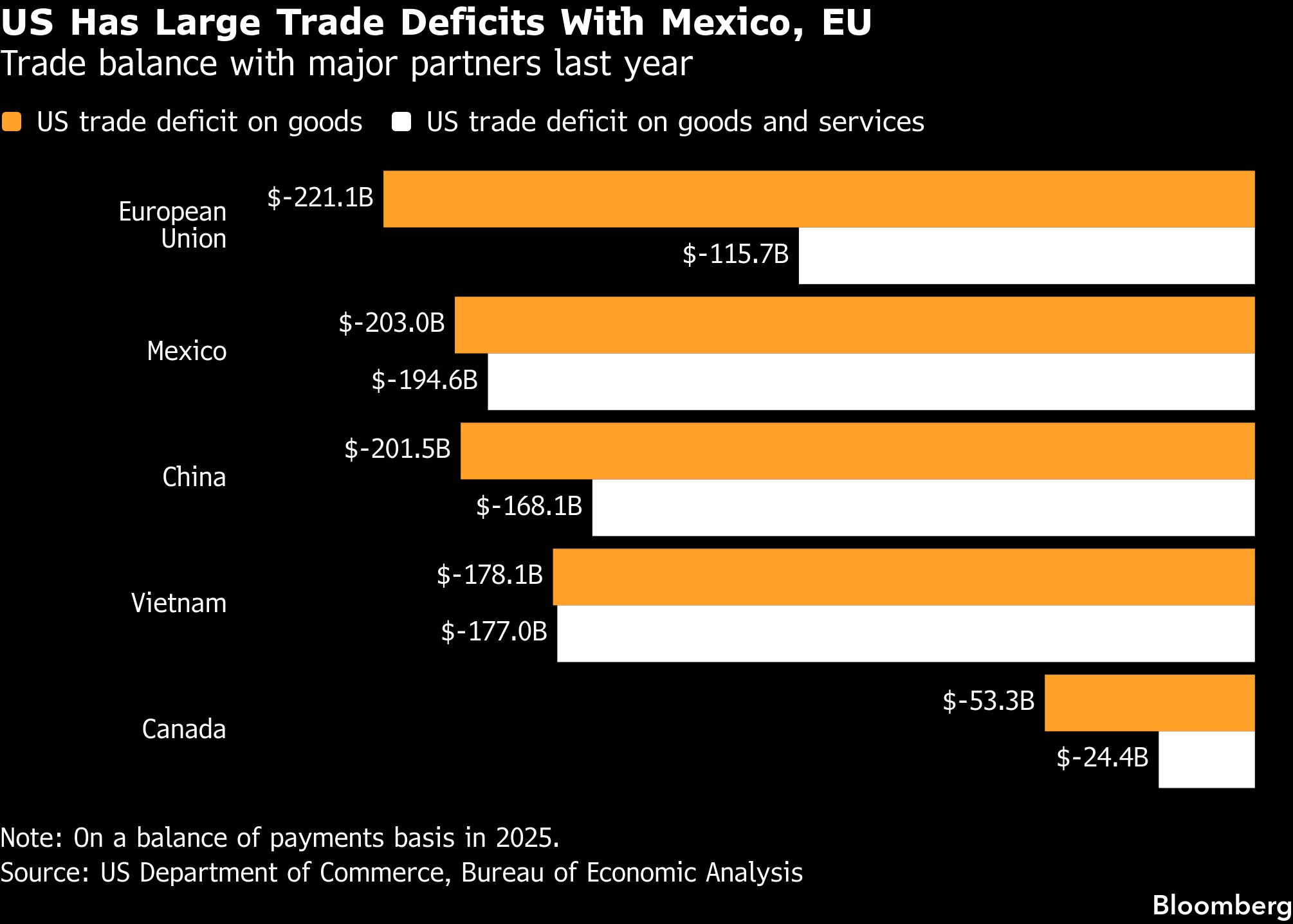
The economic stakes are huge for all three countries in USMCA, which was called Nafta before Trump renegotiated and rebranded it. They do almost $2 trillion in annual trade with each other, and USMCA-compliant goods have largely been exempt from Trump’s barrage of tariffs, including in the new duties revealed this week.
Canada and Mexico are two of the largest US trading partners and the top buyers of its goods. But they’ve still been faced with new tariffs on products such as autos and steel — straining ties and spurring boycotts.
U.S. Trade Representative Jamieson Greer has said the US wouldn’t rubber-stamp an extension of the agreement. The U.S. and Mexico have already scheduled their third round of talks for mid-July, while the U.S. has had less formal discussions with Canada.
Dominic LeBlanc, the Canadian minister responsible for US trade, met with Greer this week in Washington and afterward suggested July 1 shouldn’t be seen as a crucial date. “I think we’ve got to be careful not to set up a cliff that doesn’t exist,” he said.
The office of the USTR declined to comment and instead referred to recent remarks by Greer, who told France 24 that on July 1, “I don’t think we’re going to renew it outright, but we’ll engage in the separate negotiations.”
One of Trump’s goals is to pull more automotive assembly and other manufacturing jobs into the US, and he sees tariffs and trade rules as ways to do it. The White House is pushing for a new standard on new vehicles of at least 50% US content to qualify for tariff-free treatment — a condition Trump unsuccessfully sought in the renegotiation during his first term.
Familiar irritants have also popped up again, such as Canada’s dairy management system that restricts imports. And defense programs are also a source of tension, such as whether Canada will follow through on an order of F-35 fighter jets.
It’s not clear how far the White House can go in changing the terms without altering the legal text of the USMCA, which could require a politically unpalatable vote in Congress.
Greer has signaled the administration wants changes without going to Congress, some of the people said, preferring instead to squeeze Canada and Mexico for concessions that would be spelled out in side letters or “protocols.”
Canada’s chief trade negotiator, Janice Charette, has described them as focused on a “kind of snap-on Lego bilateral piece” added to the original deal.
Senior officials in Canadian Prime Minister Mark Carney’s government are pushing to get an agreement to address the steep tariffs Trump imposed on steel, aluminum, autos and lumber.
Carney annoyed Trump with a speech in Davos that accused the world’s superpowers of coercive tactics, but he has taken a more conciliatory approach recently. He used an event in New York to publicly pitch the US on closer cooperation on critical minerals such as potash and uranium. Trump is also keen on a modified version of the Keystone XL oil pipeline from Canada.
This week, Carney’s government backed off a plan to force major streaming companies such as Netflix Inc. and Walt Disney Co. to spend 15% of their annual Canadian revenue on local content. The U.S. ambassador in Ottawa praised that decision.
But Canadian officials are nevertheless bracing for a scenario in which tariff negotiations drag on for years, perhaps all the way through the end of Trump’s term in 2029.
As talks intensify, they believe the president may do more of what he’s done since January 2025—hitting Canada with new tariffs or denouncing its government in social media posts—and may even threaten to pull the US out of the trade deal to add pressure and force concessions. After his meeting with Greer, LeBlanc sounded an optimistic tone but warned of “turbulence” ahead.
Talks with Mexico have focused heavily on the auto sector. Like Canada, Mexico’s economy is suffering due to uncertainty over tariffs. Latin America’s second-largest economy has now seen 19 straight months of negative total investment.
When asked for comment, the Mexican government referred to a letter released by Economy Minister Marcelo Ebrard in which he states the priority for USMCA should be keeping it as a three-way agreement.
It’s an open question whether Trump would agree to renew the agreement at all, or whether his administration will simply elect to keep it in constant reviews—which would make it harder for its smaller partners to win investment. If the White House doesn’t commit to renewal, Canada or Mexico may balk at making concessions.
Trump can always give six months’ notice to quit the deal altogether, something he’s privately flirted with but not publicly threatened of late.
Instead, the talks with Mexico and Canada appear headed toward side deals with each country, similar to the agreements Trump has struck with other nations to trade tariff relief for certain concessions.
Top photo: U.S. President Donald Trump and Trade Representative Jamieson Greer. Bloomberg.
- Glencore Faces $2 Billion Suit as It Alleges Radiant World Fraud
- Bayer Faces Test of $7.25B Roundup Settlement In Missouri Court
- The Nation’s Insurance Laboratory: What Liability Trends in California Mean for the Rest of the Country
- The Big Data/AI ‘Revolution’ Is Driving Up Verdicts, Settlements as Plaintiffs Buy In