Florida’s Fix for Insurance Crisis Puts More Risk on Homeowners
Florida lawmakers knew they had a billion-dollar insurance problem.
The state is a magnet for hurricanes, and the cost of damages from extreme weather has risen sharply over several decades. Scientists say this is a consequence of climate change, and a dynamic that will accelerate; many in the insurance industry say homeowners were weaponizing natural catastrophes to file fraudulent claims. Everyone agreed insurers were straining to keep up, with companies dropping hundreds of thousands of homeowners and some leaving the state altogether.
Worried about who would be left to insure Floridians, the legislature passed laws in 2023 that changed the way property insurance works there. Three years since the laws went into effect, some homeowners, lawyers and insurance company insiders say the reforms created a new set of predicaments.
Florida changed how the legal system applies to insurance companies, making it more onerous for homeowners to use the courts to challenge denied claims or low payouts. That has emboldened insurers to limit payouts on claims, according to critics as well as current and former employees at three different private homeowner insurance companies within the state. The current and former employees requested anonymity because they weren’t authorized to speak about company litigation.
Michael Yaworsky, Florida’s insurance commissioner, says the laws fixed an enormous problem. “The market was near collapse toward the end of 2022,” he said, “and if something was not done to handle the outsized litigation challenge we would have found ourselves in a place where we would be looking at very drastic or dire options.”
Yaworsky and others who supported the laws don’t talk about climate change. (A representative from his office said Yaworsky is “aware” of reports about climate change’s link to severe weather events, but he’s focused on “the direct impacts of catastrophic weather.”)
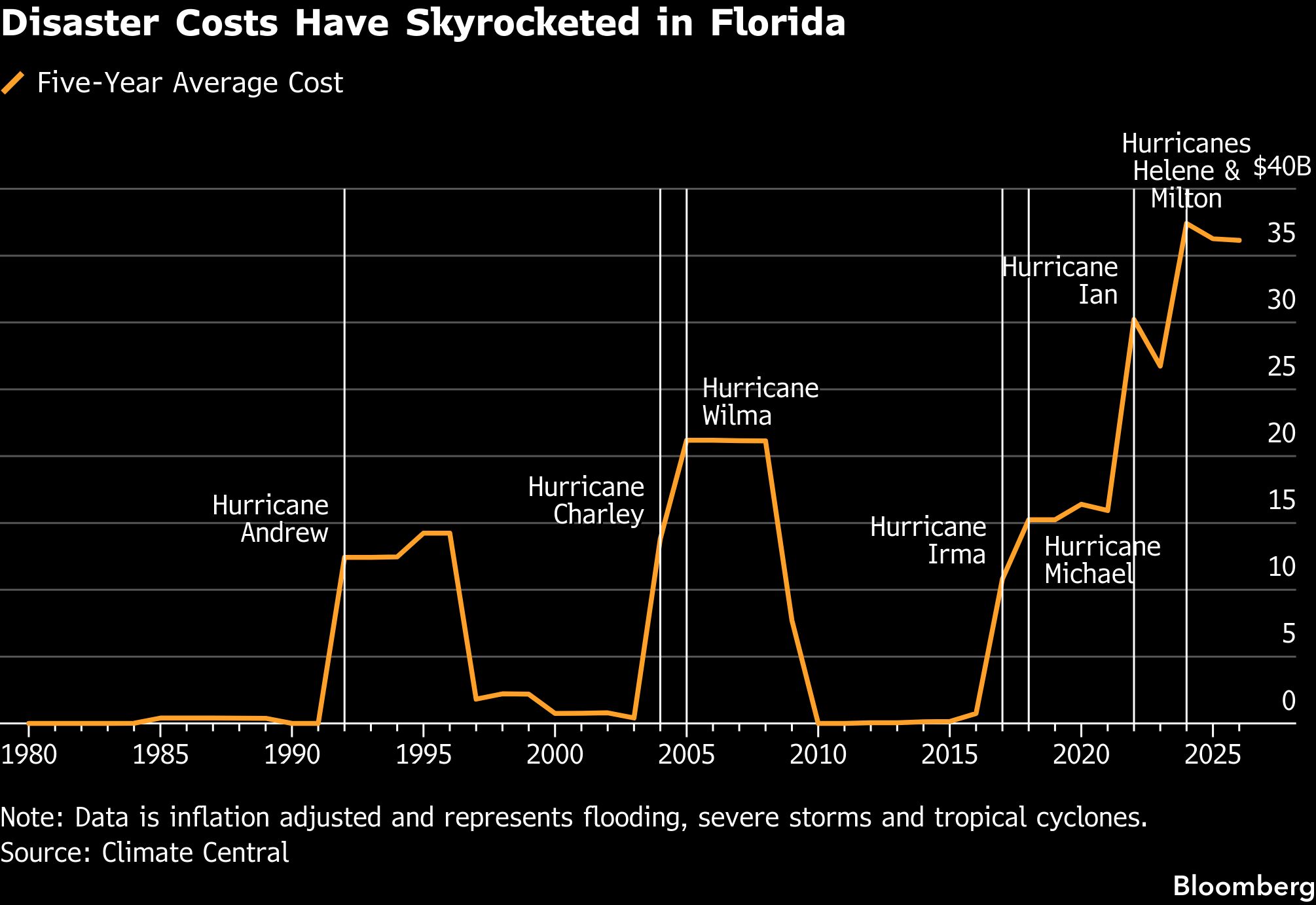
Planetary warming, though, is increasing the severity of storm weather, and Florida’s a place where you can see this up close. The inflation adjusted, five-year average cost of severe storms, flooding and tropical cyclones in Florida is more than $36 billion, according to data from Climate Central. In 2016 that figure was under $1 billion. Experts also point to increased property development and population growth as contributing factors to the explosion in costs.
The state currently has the highest home insurance premiums in the nation—an average of $8,292—according to Insurify, an insurance comparison site. (The average premium cost across the country in 2025 was $2,948.)
After mounting losses, several property insurers pulled back from the state or stopped writing new policies. This accelerated in 2022 after Hurricane Ian dealt an estimated $67 billion in private market insured losses.
Florida’s dilemma is one that many states are facing. Other parts of the country such as California, Louisiana, Texas and North Carolina have also struggled with strained insurance markets as the impact of extreme weather accelerates.
And states are paying attention to the new playbook. Since Florida passed the rules, Georgia, Louisiana, North and South Carolina have also considered similar measures aimed at reducing litigation against insurers, making it more enticing for the companies to turn a profit and stay in the state.
It’s a strain that’s spreading, according to Carolyn Kousky, a member of the Coalition for an Insurable Future, a nonpartisan group working to mitigate the insurance market collapse in the U.S.
“There is a tension between availability of insurance and affordability of insurance,” Kousky says. “Climate changes are making insurance ever more necessary because, as the planet warms, more people are having to suffer through disaster. Unfortunately, those same trends are also making insurance harder to provide, making it less available and more expensive at the moment we need it more than ever.”
The laws are changing how insurance disputes play out in Florida. Their effects are only beginning to impact homeowners now as claims slowly snake their way through the legal system.
The insurance industry lobbied heavily for the rules, arguing that the old system made it too easy for homeowners to sue their insurers frivolously or fraudulently. It was this surge in lawsuits, rather than climate-fueled weather, that was driving insurance premiums higher, they say. Fixing that fraud, the argument went, would allow insurers to lower premiums.
Lawmakers eliminated a rule that once required insurers to pay homeowners’ legal fees if they successfully challenged a claim. They also tightened standards for so-called bad-faith lawsuits and added new hurdles before cases can reach court. Critics of the reform say those changes have made it more difficult for homeowners to sue and can slow disputes as claims move through additional procedural steps.
Whether or not premiums have gone down is a matter of debate, with Florida Governor Ron DeSantis touting decreases, and independent groups finding that they have risen.
“Premiums are lowering because we’ve enacted real reforms and withstood the pressure to reverse course,” DeSantis said in a January statement. He cited premium reductions of 8.2% for Florida Peninsula customers, an 8% reduction at Security First and a 5.1% reduction at Universal Property & Casualty Co.
But according to Insurify, on average, premiums in Florida have gone up 14.3% since the reform went into effect, and they’ll continue to rise. The site projects a 2% increase this year. In fact, higher insurance costs are one of the reason’s making Miami more expensive than New York City.
A representative from DeSantis’s office declined to comment further on the data or effects of the laws.
For homeowners reckoning with damage after a disaster, it’s harder to wrest settlements out of their insurer, according to a report released by the National Association of Insurance Commissioners in July.
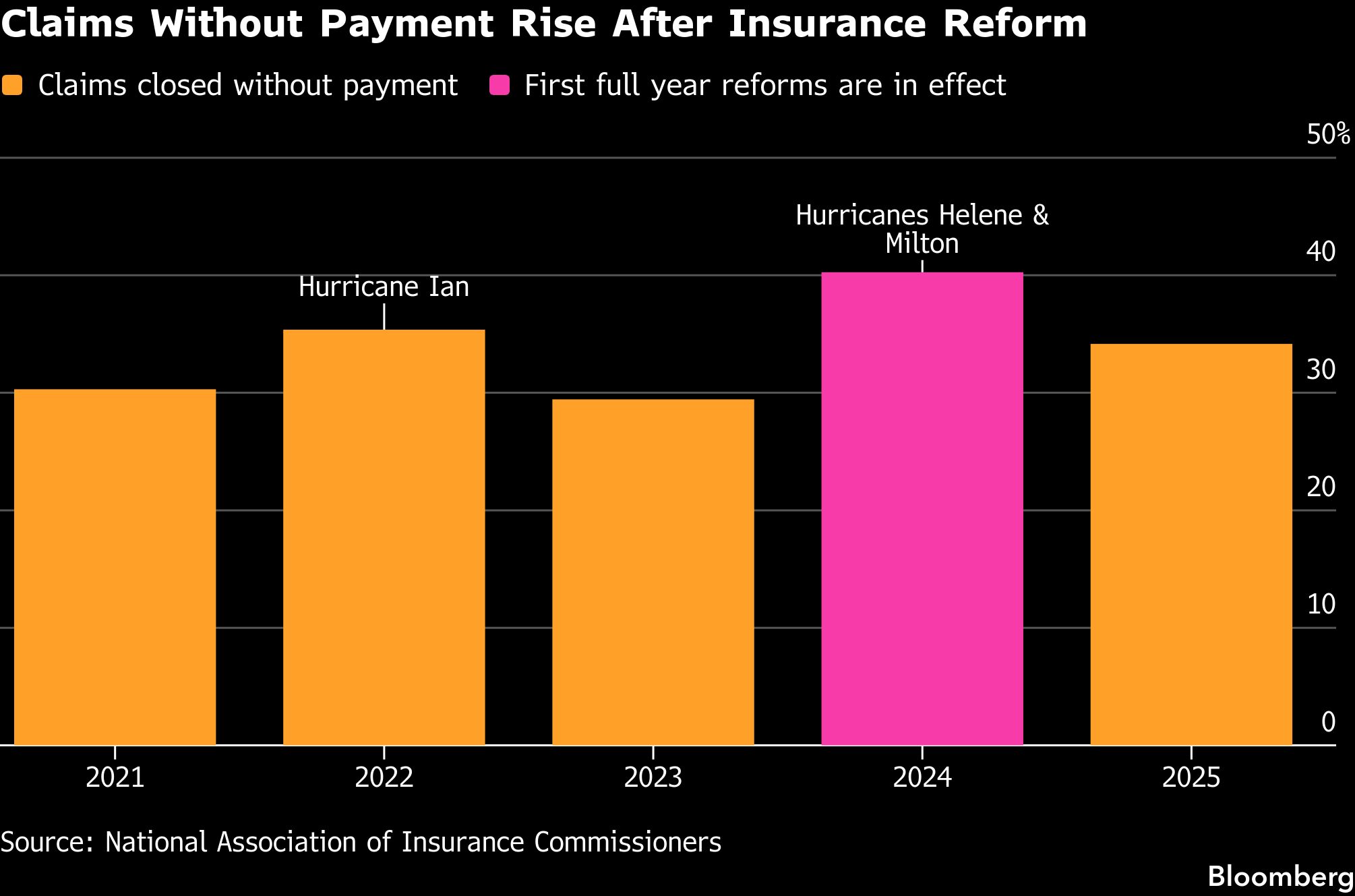
The number of claims closed without any payment at private home insurers in Florida increased by five percentage points between 2022 and 2024 to 40.3% when hurricanes Helene and Milton hit. That year, Florida had more claims closed without payment than any other state in the US.
And according to former employees at Universal, the state’s largest private insurer, there was a push to offer lower payments after the laws were passed. One former lawyer for the company says that their managers authorized settlement amounts that were way below what they felt was owed to the consumer. The person would get authorization from their bosses for $5,000 to $10,000 to settle a claim that they felt was really worth tens of thousands of dollars.
“Every time I asked for money, it was like pulling teeth,” the person says.
The former employees say they litigated cases where it was obvious to them that the payout to the homeowner was too low, but they felt pressured by their superiors at the insurer to make a low offer anyway. This got worse after the Florida rules passed, the former employees say. “We didn’t pay for what we owe,” one says.
A representative for Universal said the reforms have strengthened Florida’s property insurance market and benefitted consumers. Because of the changes, Universal is adding new customers across Florida and the insurer has been decreasing its rates since 2024. Claim denial rates have “significantly declined” as well, they added.
“The data clearly shows lower rates, faster claims handling, improved customer service, fewer complaints, and dramatically reduced litigation,” the representative said.
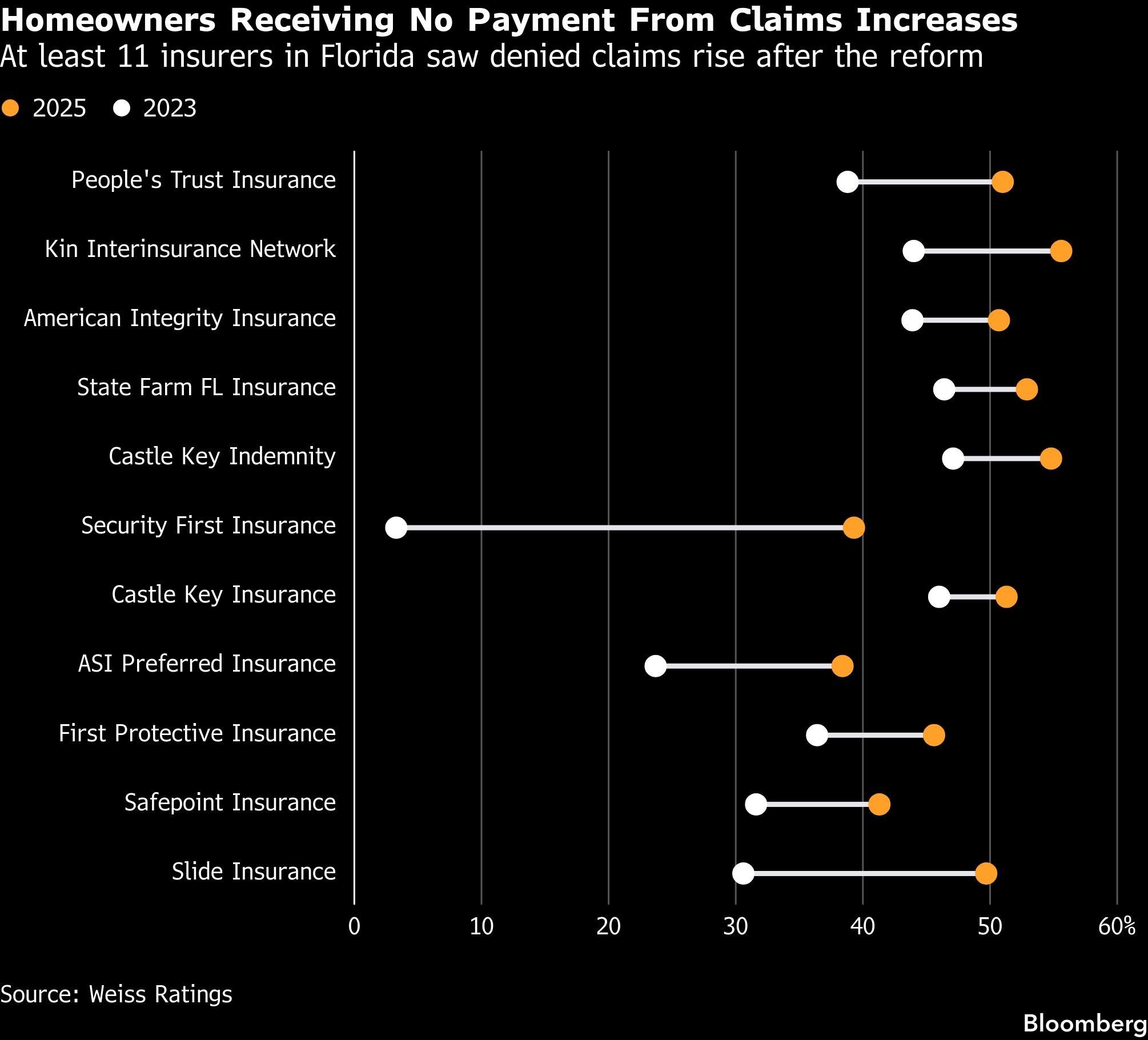
But closing cases without paying settlements is still on the rise at some Florida insurance companies, reports Weiss Ratings, which provides financial analysis for property and casualty insurance companies. At least 11 property insurers in Florida closed more claims without payment in 2025 than they did in 2023.
“It’s the biggest giveaway in history to insurance companies,” says Keith Ligori, a personal injury attorney in the Tampa Bay area who has been practicing law for 25 years. “Insurance companies are lowballing the offers more than ever.” There is, he says, “bad faith.”
Weiss Ratings also found that Floridians are being dropped from their home insurers at a faster rate than people in any other state in the US.
The new laws are breaking the business model for attorneys who make their living from filing claims to recover insurance money owed to homeowners, those litigators say. The rule about who pays everyone’s legal fees has been especially impactful: it used to be the insurer who paid when it lost, and now it’s the homeowner.
That makes it almost impossible to recover all of the losses owed to the property owner despite having their claim validated in court by a jury, according to Powers. Residents can’t be made whole, when legal fees are taken into account.
Homeowners can lose up to half of their settlements, he says.
Because it’s no longer profitable for attorneys to take smaller cases, the rules have effectively rendered homeowner claims valued at tens of thousands of dollars ineligible for lawsuits.
Candice Colucci says that much of her practice, based in Clearwater, helps storm victims recover insurance payments. But the new laws have limited the cases that she can take and still be profitable as a business. Now she doesn’t consider claims under $100,000, and she believes the insurance companies factor that into their decisions.
“It enables them to deny a claim or underpay,” she says.
Citizens, the state-backed insurer, is now able to bypass the courts altogether. A new policy allows lawsuits against Citizens instead to be arbitrated through the Florida Division of Administrative Hearings, a state agency. This is a situation unique to Citizens, and critics say this shields the state insurer from legal challenges, enabling them to win a majority of cases.
“It is a transparent process that brings resolution much more quickly for policyholders,” says Michael Peltier, a spokesman for Citizens. Citizens wins most of its final hearings this way because most cases are dropped or settled prior to that, according to the insurer. Less than 1% of all Citizens’ claims are referred to the agency, Peltier says.
Robert Gordon, a senior vice president at the American Property Casualty Insurance Association, an industry trade group, says that reducing the amount of lawsuits has made the system more efficient.
“It’s had a fabulous effect on Florida,” Gordon says. “It’s all about affordability.”
Anders Croy, communications director for Florida Watch, a nonprofit citizen advocacy group, sees property insurance becoming unaffordable while climate change makes the problem worse.
“Folks are paying out the nose for their premiums,” he says. “And then when disaster strikes, they’re finding that they can’t rely on the people that they have been paying to make good on the legitimate claims that they are filing in order to get their lives back.”
Jennifer and RJ Garbowicz were forced to demolish their St. Petersburg home after it was hit by both Hurricanes Helene and Milton, which slammed into Florida’s west coast less than two weeks apart in 2024. Despite having a home insurance policy limit of $713,000, the family was told their insurer would pay them $2,279.41, according to documents reviewed by Bloomberg News. The family has been displaced from their home since the storms struck 22 months ago.
For the Garbowiczes, the covenant between the insurer and the insured has been broken. They paid premiums for years, only to be left with a fraction of what the policy was for. They are now suing their home insurance carrier seeking a larger payout to help them rebuild.
But even if the family wins in court, it won’t be enough to cover the cost of reconstructing their home how it was. “You have expectations that when you need to use it, the outcome will be clear and will be fair,” Jennifer says. “That’s not how it feels.”
Top photo: The home of Jennifer and RJ Garbowicz was demolished after Hurricane Helene destroyed it. Photographer: Michael Adno/Bloomberg.
- Suspended Glencore Exec Told Radiant ‘Say Nothing on Email’
- The Great Hemp Reset: How the Federal Ban on Intoxicating Hemp Products Will Reshape Risk and Coverage
- Severe Convective Storms: Risk, Field Reality and the Path to Resilience
- Torrential Rain Brings Deadly Floods Back to East Coast of Spain