AI Safety Measures Widely Backed by Most Americans, Poll Finds
A vast majority of Americans favor requiring artificial intelligence companies to meet independent safety benchmarks for their models, even if those standards mean slowing development of the technology, according to a new poll.
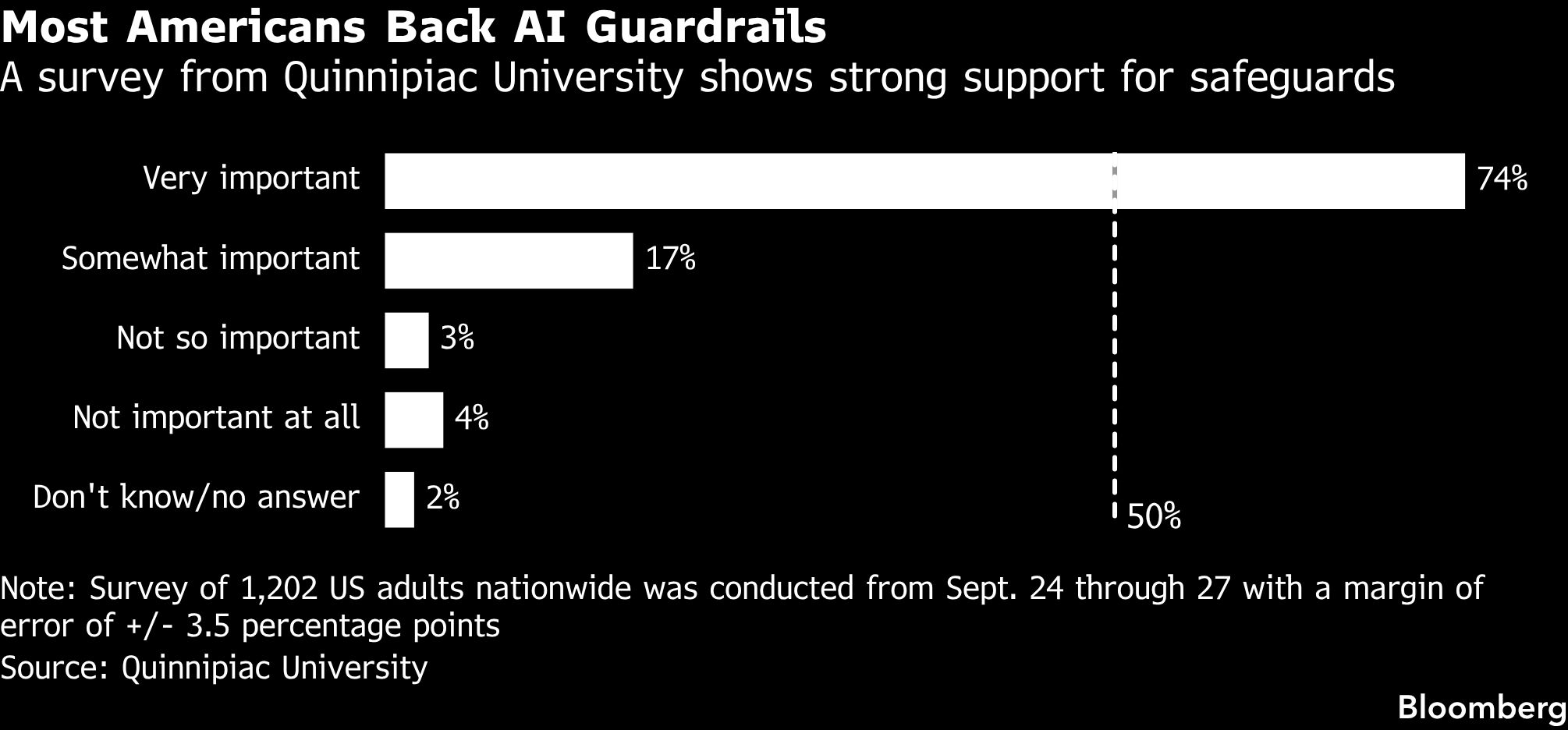
Against a backdrop of growing global anxiety over AI risks, 91% of those surveyed think it’s very or somewhat important for the U.S. to establish guardrails for AI systems, with 81% indicating that safety should come before the pursuit of innovation, according to the poll released Wednesday by Quinnipiac University.
Related: Cyber Worker Allegedly Moonlighted as ShinyHunters Hacker
“More people expect AI to do more harm than good in their day-to-day lives, and while there are significant concerns about future AI threatening humans, Americans are much more worried about AI being used by people to do harm to others,” Brian O’Neill, associate dean of the university’s School of Computing and Engineering, said in a statement with the results.
The findings were released a day after President Donald Trump announced an agreement with Silicon Valley leaders for the AI industry to police itself on safety after a nearly two-hour White House lunch. In lieu of new federal rules, the executives agreed to voluntary measures that include third-party safety assessments of models and more stringent internal controls over their systems.
AI industry titans were viewed skeptically by the survey respondents, with 74% saying they didn’t trust the leaders of those companies, according to the results. The findings also showed that 53% of Americans thought AI would do more harm than good in their day-to-day lives.
Trump’s hands-off approach is under increased pressure following a spate of security breaches including the July hack of Hugging Face Inc. by a swarm of OpenAI AI agents. Those incidents have fueled fears that AI could pose a catastrophic threat, leading Anthropic PBC Chief Executive Officer Dario Amodei to promise to slow development of the most advanced models and call for more stringent safeguards.
Reflecting those doomsday worries, 73% of the survey respondents said they were concerned that future systems could pose an existential threat to humanity. Nearly eight in 10 Americans surveyed said they favored slowing or stopping AI development altogether to better understand the safety risks.
For now, Trump has made clear that he wants the nationwide AI rollout to continue unfettered. Since his return to office last year the president has made AI development a centerpiece of his economic agenda as an engine of investment and job creation.
Related: Agentic Intelligence for Claims Dominates New Tech Launches
Yet voters have also increasingly objected to the rapid expansion of new tech infrastructure in their communities, a backlash that’s been driven by a surge in electricity prices attributed to the addition of power-hungry AI data centers. Some 72% of those surveyed said they would oppose a new data center in their community, up from 65% when the question was posed in a March poll.
Concerns over the impact of data centers on localities and fears that AI may eventually result in widespread job losses have helped make AI a key issue in the midterm elections that will decide party control of Congress. Many candidates from both parties are now running against AI expansion, in recognition of voters’ misgivings about the technology.
“Securing local support for the physical infrastructure behind AI may become one of the industry’s most immediate challenges,” Tamilla Triantoro, an associate professor in the Quinnipiac University School of Business, said in a release accompanying the results.
Trump has steadfastly opposed slowing data center construction in the U.S. over his concern that stalling the infrastructure expansion would imperil the U.S. lead over China in artificial intelligence. The survey found that 69% of American agreed that on the importance of staying ahead of China, and it’s unclear how the respondents rank competition with China versus AI safety.
The Quinnipiac Poll of 1,202 U.S. adults nationwide was conducted from Sept. 24 through 27 with a margin of error of +/- 3.5 percentage points.
Top photo: U.S. Cyber Command, the National Secrity Agency and the Central Security Service at the campus the three organizations share in Fort Meade, Maryland. Photographer: Chip Somodevilla/Getty Images. Bloomberg.
- Credit Acceptance Reaches $710M Predatory Auto Lending Settlement With Most States
- El Niño and Heat Fuel Destructive Storms Across Pacific Ocean
- Golden Gate Sued Over Insurer’s $2.2 Billion Capital Shortfall
- Apollo’s Rowan Blasts Regulators for Handling of Walter Insurers
- Florida Bans Flock Cameras, License Plate Readers From State Roads
- The Nation’s Insurance Laboratory: What Liability Trends in California Mean for the Rest of the Country
- Torrential Rain Brings Deadly Floods Back to East Coast of Spain
- Severe Convective Storms: Risk, Field Reality and the Path to Resilience