Companies Haven’t Been This Worried About El Niño in a Decade
As this year’s powerful El Niño approaches its peak, companies are sounding increasingly anxious about the business toll of the extreme weather it brings, from higher lending risks to weaker demand for their products.
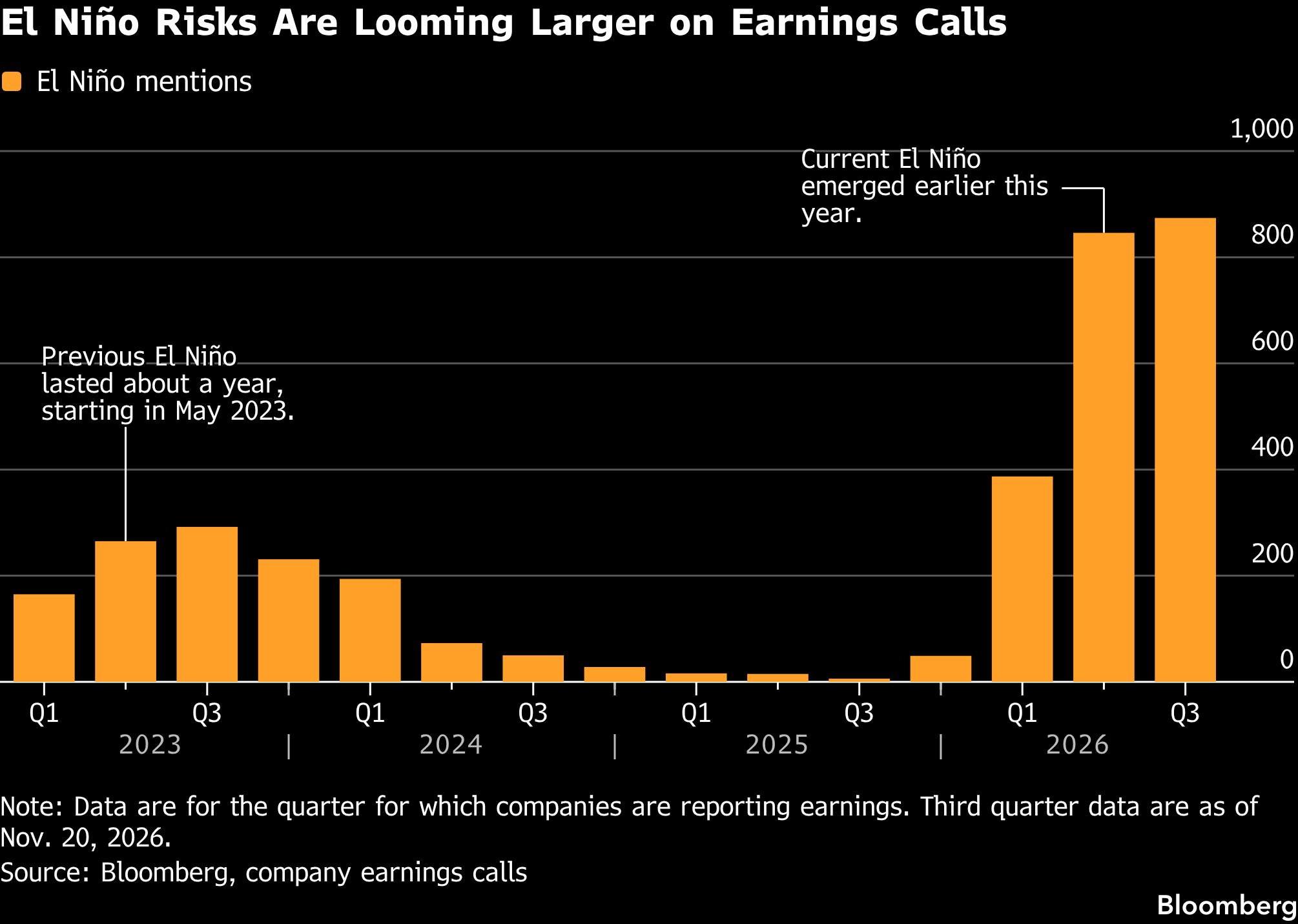
Executives mentioned the weather phenomenon more than 600 times in third-quarter earnings calls in November, according to data from publicly traded companies around the world compiled by Bloomberg. That’s more than in any single month over the past decade, even though there have been three other El Niño cycles during that period, including a particularly strong one that wound down in 2016.
“This is not just any El Niño,” said Mekala Krishnan, who advises business leaders on climate risks at consulting firm McKinsey. “This is the super El Niño.”
El Niño Risks Are Looming Larger on Earnings Calls
The current El Niño phase is on track to eclipse its modern predecessors as it continues to fuel fires, floods and droughts across multiple continents. It’s expected to fade beginning in the Northern Hemisphere’s spring, but its weather effects — and impact on businesses — will likely ripple out for months.
Some companies are already feeling those effects. German chemical giant Bayer AG said in November that sales of its core crop protection business, which includes pesticides and herbicides, declined this year in part because of a strong El Niño.
El Niño is adding to a year of climate-fueled disruptions for businesses, including record summer heat waves in Europe that evaporated $128 billion in economic output.
The potential financial fallout is starting to come into focus across global supply chains. Denver-based Newmont Corp., the world’s largest gold miner, warned that El Niño-induced drought could curb water supplies at its Papua New Guinea mine in the fourth quarter.
“The timing and severity of weather impacts could influence production and costs during the quarter,” Newmont’s chief financial officer said on its October earnings call.
For Vancouver-based mining company Pan American Silver Corp., the threat comes from heavier-than-normal rainfall in Argentina, which has snarled transportation and complicated ore processing.
U.S. seed producer Vylor Inc. said earlier this month on its third-quarter earnings call that lower sales due to historic drought in Europe and the effects of El Niño in the Asia Pacific shaved off $60 million from earnings.
“If the weather’s not good, you don’t plant as much, you don’t apply as much fertilizer,” said Salvator Tiano, an analyst at KeyBanc Capital Markets.
Still, while reduced planting is likely to dampen fertilizer sales through the first quarter of 2027, tighter harvests could raise crop prices and incentivize farmers to spend more later in the year, Tiano said.
Likewise, El Niño is likely to affect some energy companies more than others. A milder winter in the Northern Hemisphere could undercut heating demand, potentially depressing natural gas prices in the U.S. and Europe. Tourmaline Oil Corp., Canada’s largest natural gas producer, described the market sentiment around El Niño as “a bit of a wall of worry” during its November earnings call.
But higher temperatures would offer much-needed relief for utilities in Europe that rely on imported natural gas for heating, particularly after conflicts in the Middle East have sent global gas prices sky-high, according to TD Cowen analyst Jason Gabelman.
As they brace for El Niño’s continuing effects, companies are scrambling to insulate their balance sheets against weather-linked losses.
In Peru, where El Niño is expected to bring flooding to the north and severe drought in the south, Credicorp is slowing new lending to small and medium-sized enterprises, a segment more vulnerable to weather shocks. The company, which owns the country’s largest bank, told analysts on Nov. 10 that it is “taking this risk seriously.”
For many corporations, this El Niño cycle comes on top of disruptions from the war in Iran, including supply chain bottlenecks, higher production costs and growing concerns about the global economy.
“There’s just so many different changes and disruptions happening,” said Krishnan of McKinsey. “It is everything, everywhere, all at once.”
Top photo: Workers use a plank of wood to attempt to secure a window shattered by crashing waves at a restaurant in Malibu, California, on Saturday, Oct. 10, 2026. Last year’s wildfires and now El Niño’s damaging waves are testing the enduring appeal nd extraordinary prices of living at the edge of the Pacific in Malibu. Bloomberg.